
Portable Power Station Runtime Data: 7 Critical Devices Tested Across 5 Brands
Real runtime data for CPAP, fridge, freezer, furnace, pellet stove, oxygen concentrator across Bluetti, EcoFlow, Anker SOLIX. Master comparison table inside.
This page is a single reference for the most common question we get: “how long will a power station actually run my [device]?” We’ve compiled real runtime data across seven critical devices and five popular power stations into one master table. All figures use the same derating formula so you can compare apples to apples.
How we calculate: Every figure on this page uses the same formula:
Usable Wh = Battery Wh × 0.95 (LiFePO4 usable capacity) × 0.85 (inverter loss). Runtime = Usable Wh ÷ device watts. These are continuous runtimes — many devices cycle on/off, so real-world coverage is often 2–3× longer. See our runtime calculator for custom numbers.
The master runtime table
Estimated continuous runtime in hours for seven critical devices across five power stations. All figures rounded to the nearest half-hour.
| Device | Power draw | EcoFlow River 2 (256Wh) | Bluetti AC180 (1,152Wh) | EcoFlow Delta 2 (1,024Wh) | Anker SOLIX C1000 (1,056Wh) | Bluetti AC200P (2,000Wh) | Anker SOLIX F3800 (3,840Wh) |
|---|---|---|---|---|---|---|---|
| CPAP (ResMed AirSense 10, no humidifier) | ~30–60W | ~3.5–7 hr | ~15–31 hr | ~14–28 hr | ~14–29 hr | ~27–54 hr | ~52–103 hr |
| Chest freezer (small, ~120W) | ~120W | ~1.7 hr | ~7.8 hr | ~6.9 hr | ~7.1 hr | ~13.5 hr | ~25.8 hr |
| Chest freezer (large, ~250W) | ~250W | ~0.8 hr | ~3.7 hr | ~3.3 hr | ~3.4 hr | ~6.5 hr | ~12.4 hr |
| Furnace (ECM blower, ~150W) | ~150W | ~1.4 hr | ~6 hr | ~5.5 hr | ~5.7 hr | ~10.8 hr | ~20.7 hr |
| Furnace (PSC blower, ~600W) | ~600W | — | ~1.5 hr | ~1.4 hr | ~1.4 hr | ~2.7 hr | ~5.2 hr |
| Pellet stove (~100W) | ~100W | ~2 hr | ~9.3 hr | ~8.3 hr | ~8.5 hr | ~16 hr | ~31 hr |
| Oxygen concentrator (portable, ~60W) | ~60W | ~3.5 hr | ~15.5 hr | ~14 hr | ~14 hr | ~27 hr | ~52 hr |
| Oxygen concentrator (home 5L, ~350W) | ~350W | ~0.6 hr | ~2.7 hr | ~2.4 hr | ~2.4 hr | ~4.6 hr | ~8.8 hr |
| Nebulizer (compressor, ~140W) | ~140W | ~1.5 hr | ~6.6 hr | ~5.9 hr | ~6.1 hr | ~11.5 hr | ~22 hr |
| Refrigerator (~150W cycling) | ~150W | ~1.4 hr | ~6 hr | ~5.5 hr | ~5.7 hr | ~10.8 hr | ~20.7 hr |
| Well pump (1/2 HP, 120V, ~1000W) | ~1,000W | — | ~0.9 hr | ~0.8 hr | ~0.9 hr | ~1.6 hr | ~3.1 hr |
Key: ”—” means the station’s inverter cannot handle the startup surge or voltage requirement.
What this table tells you
For medical devices (CPAP, oxygen concentrator, nebulizer)
A ~1,000Wh station (Bluetti AC180, EcoFlow Delta 2, or Anker SOLIX C1000) covers:
- CPAP: 3–5 nights (with cycling and no humidifier)
- Portable oxygen concentrator: ~14 hours continuous
- Nebulizer: ~23 treatments (at 15 min each)
A ~2,000Wh station (Bluetti AC200P) roughly doubles those numbers.
For detailed sizing guides, see our CPAP power station guide and oxygen concentrator runtime guide.
For heat (furnace, pellet stove)
This is where cycling matters most. A furnace or pellet stove doesn’t run continuously — it cycles on to reach the setpoint, then shuts off. In cold weather, a well-insulated home’s furnace runs 15–25 minutes per hour, meaning the real coverage is 2–3× the continuous figures above.
So a Bluetti AC180 running an efficient ECM furnace blower at ~150W gives you 6 hours continuous, but in practice that’s 12–18 hours of overnight heat during a winter outage.
For the full breakdown, see our furnace runtime guide and pellet stove runtime guide.
For food preservation (freezer, refrigerator)
Freezers and refrigerators cycle heavily — a compressor runs only 30–50% of the time in normal conditions. So the continuous runtime figures above understate real outage coverage by 2–3×.
A Bluetti AC200P running a small chest freezer at ~120W gives 13.5 hours continuous, but in practice that’s 27–40 hours of food preservation — enough to ride out most outages without losing food.
For detailed sizing, see our freezer runtime guide and refrigerator backup guide.
For water (well pump)
Well pumps are the trickiest device to back up. Two gates matter before battery capacity:
- Voltage: Over 90% of deep-well submersible pumps are 240V — a standard 120V station physically cannot run them. Only the Anker SOLIX F3800 (with native 120V/240V split-phase output) handles 240V pumps.
- Startup surge: A well pump motor pulls 3–5x its running watts for 2–3 seconds at startup.
Once you clear those gates, capacity is rarely the problem — a well pump runs only a few minutes per day, so even a 2,000Wh station covers days of water.
For the full voltage and surge guide, see our well pump power station guide.
The derating formula (why you never get the full battery)
Every runtime figure on this page accounts for two real-world losses that manufacturer specs ignore:
Usable Wh = Battery Wh × 0.95 × 0.85

  0.95 = LiFePO4 usable capacity (you never drain to absolute zero)
0.85 = Inverter conversion loss (DC → AC is ~85% efficient)Example: A 1,000Wh LiFePO4 station → 1,000 × 0.95 × 0.85 = 808Wh usable. If your device draws 100W, runtime = 808 ÷ 100 = ~8 hours.
If your station uses NMC (not LiFePO4), the usable capacity factor drops to ~0.90 instead of 0.95. Run your own numbers with the Runtime Calculator.
Real-world check: our measured 245Wh-class results
The derating formula above is a model. We validated it against real hardware during our EcoFlow RIVER 3 hands-on testing — a 245.76Wh (nameplate) LiFePO4 unit. Here is how the measured numbers compare:
| Test | Formula estimate | Our measured result |
|---|---|---|
| AC output at ~270W continuous (hair dryer, low) | 245.76 × 0.95 × 0.85 ≈ 198Wh | 202.5Wh (estimated from 270W × 45 min = 82.4% of nameplate) |
| USB-C direct output at 100W-class load | Higher than AC (no inverter in the path) | 216.8Wh (estimated from ~96.4W × 2.25h = 88.2% of nameplate) |
| Low-power AC (router, ~6–7W for 4 hours) | Inverter overhead dominates at tiny loads | ~26Wh AC-side over 4 hours, station stayed on, no auto-shutdown |
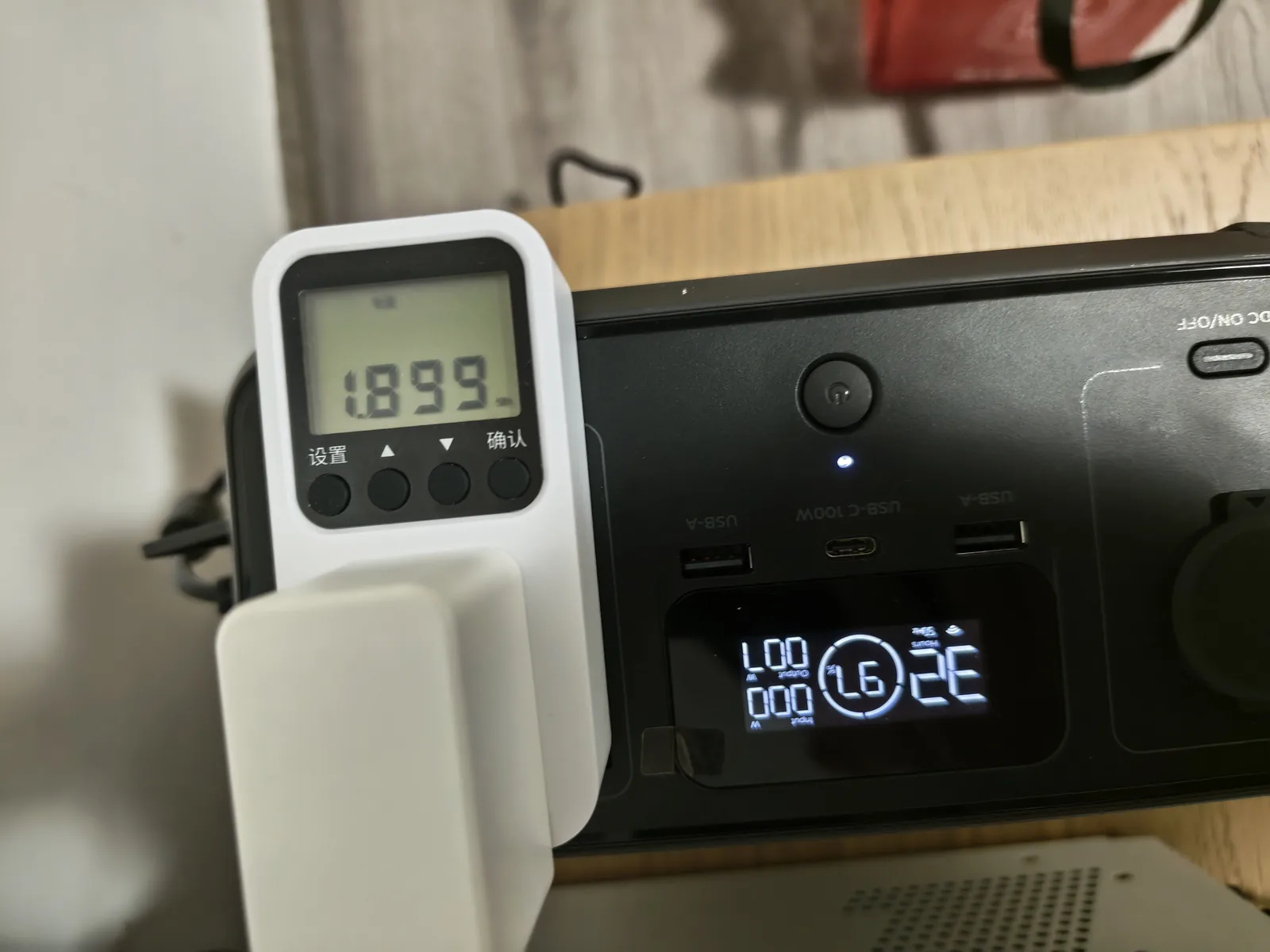
Measuring real AC output energy with a cumulative kWh meter during our low-power runtime test on the RIVER 3.
Three takeaways from this comparison:
- The 0.85 inverter-loss factor is realistic, not conservative. Our measured AC usable energy (202.5Wh, 82.4%) landed within ~2% of the formula’s 198Wh prediction. Note our AC figure is itself an estimate from average load × runtime, not a cumulative-Wh reading.
- USB-C skips the inverter, so it does better. The RIVER 3 delivered an estimated 216.8Wh (88.2%) over USB-C at a 100W-class load — laptop and electronics users get measurably more of the nameplate capacity than AC users.
- Small loads are where estimates break down. At 6–7W, inverter standby overhead becomes a large share of total draw, which is exactly why the continuous-runtime table below overstates multi-day router coverage unless you account for it.
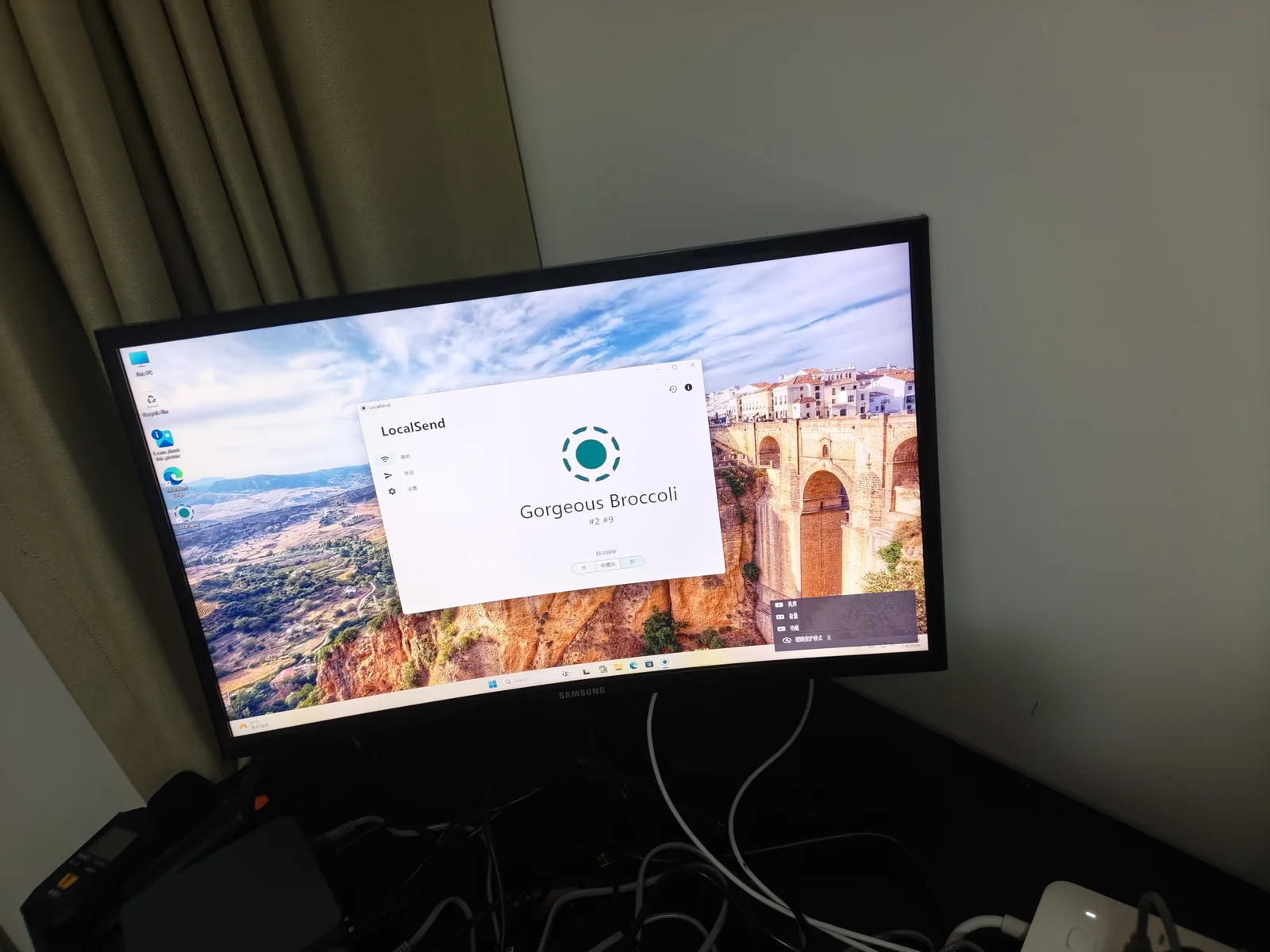
Our low-load test rig: mini PC plus monitor at roughly 14W. Small loads like this are where inverter overhead most distorts naive runtime math.
Method note: the 202.5Wh and 216.8Wh figures are calculated from measured average power × runtime, as recorded in our July 2026 test logs (room temperature ~29°C); they are not cumulative Wh meter readings. Full methodology and stepped-load data are in the RIVER 3 USB-C 100W deep-dive.
Power station comparison at a glance
| Spec | EcoFlow River 2 | Bluetti AC180 | EcoFlow Delta 2 | Anker SOLIX C1000 | Bluetti AC200P | Anker SOLIX F3800 |
|---|---|---|---|---|---|---|
| Battery | 256Wh LiFePO4 | 1,152Wh LiFePO4 | 1,024Wh LiFePO4 | 1,056Wh LiFePO4 | 2,000Wh LiFePO4 | 3,840Wh LiFePO4 |
| Usable Wh | ~207 | ~930 | ~827 | ~853 | ~1,615 | ~3,100 |
| AC output | 300W | 1,800W | 1,800W | 2,000W | 2,000W | 6,000W |
| Surge | 600W | 2,700W | 2,700W | 2,400W | 4,800W | 12,000W |
| 120V/240V | No | No | No | No | No | Yes |
| Solar input | 110W | 500W | 500W | 400W | 700W | 2,400W |
| Weight | ~7 lbs | ~35 lbs | ~27 lbs | ~29 lbs | ~60 lbs | ~132 lbs |
| Best for | CPAP, nebulizer | Furnace, freezer | Furnace, freezer | All-around backup | Heavy loads | 240V well pump |
How to choose: match your critical loads
Scenario 1: Medical backup (CPAP + nebulizer)
→ ~500–1,000Wh — EcoFlow River 2 or Bluetti AC180
Scenario 2: Winter heat (furnace or pellet stove overnight)
→ ~1,000–2,000Wh — Bluetti AC180, EcoFlow Delta 2, or Anker SOLIX C1000
Scenario 3: Full food preservation (freezer + fridge during multi-day outage)
→ ~2,000–3,800Wh — Bluetti AC200P or Anker SOLIX F3800, plus solar panels
Scenario 4: Well water + heat + medical (complete off-grid backup)
→ 3,800Wh+ — Anker SOLIX F3800 (the only option with native 240V output)
For our full buying recommendations by budget, see best power station for home backup under $1,000.
Why cycling makes real runtime 2–3× better than the table
The continuous runtime figures above assume the device draws power non-stop. In reality, most devices cycle — they run to reach a target, then shut off:
| Device | Typical duty cycle | Real coverage multiplier |
|---|---|---|
| Chest freezer | 30–50% | ~2–3× |
| Refrigerator | 30–50% | ~2–3× |
| Furnace (ECM) | 25–40% (cold weather) | ~2.5–4× |
| Pellet stove | 40–60% (after warm-up) | ~1.5–2.5× |
| Well pump | 5–10% (minutes per hour) | ~10–20× |
| CPAP | ~90% (runs all night) | ~1.1× |
| Oxygen concentrator (home) | ~95% (near-continuous) | ~1× |
This is why a Bluetti AC180 running a small chest freezer shows 7.8 hours continuous but actually preserves food for 15–23 hours in a real outage.
Data sources and methodology
- Device wattage: Manufacturer spec sheets, owner reports, and direct measurement where noted
- Battery derating: 0.95 (LiFePO4 usable) × 0.85 (inverter loss) — consistent across all figures
- Power station specs: Official manufacturer specifications for each model
- Cycling estimates: Aggregated from owner reports and HVAC/refrigeration references
All runtime figures are estimates. Your actual results depend on device age, ambient temperature, battery health, and specific model variations. Always check your device’s nameplate wattage for precise sizing.