
How Long Will a Power Station Run a Pellet Stove?
Runtime math for running a pellet stove on a power station: why it dies without power, the ignition surge, and how small a unit you actually need.
The short answer: a pellet stove is one of the easiest heat sources to back up — a 1,000Wh power station runs one for roughly 8–10 hours of burn time, and longer with cycling. Unlike a wood stove, a pellet stove is useless in an outage without electricity — it needs power to feed pellets, ignite, and vent — so every pellet-stove owner needs a backup plan. The good news: once it’s running, a pellet stove only draws 80–150W, so even a modest power station carries it through a cold night.
Important — winter heat is a safety matter. This article covers the electrical side: watts, watt-hours, and runtime. A pellet stove’s combustion and venting work normally when battery-powered, so there’s no extra carbon-monoxide risk beyond normal operation — but in a hard freeze always keep a backup heat source and never improvise wiring. Most pellet stoves plug into a standard outlet, which makes them simpler to back up than a hardwired furnace.
Why a pellet stove needs power at all (and a wood stove doesn’t)
This is the part people miss until the lights go out. A wood stove burns with zero electricity. A pellet stove is an electric appliance that happens to burn pellets — it relies on power for four things:
- Auger motor — augers pellets from the hopper into the burn pot
- Igniter — a hot rod that lights the pellets (only at startup)
- Exhaust/combustion blower — pulls air through the fire and vents it outside
- Convection (room) blower + control board — pushes warm air into the room
Cut the power and all four stop — the stove shuts down. That’s why a pellet stove, despite being a “fire,” leaves you cold in an outage unless you’ve planned backup power. The flip side: those components together draw very little, so backing it up is cheap and easy.
What a pellet stove actually pulls
| Phase | Power draw | Notes |
|---|---|---|
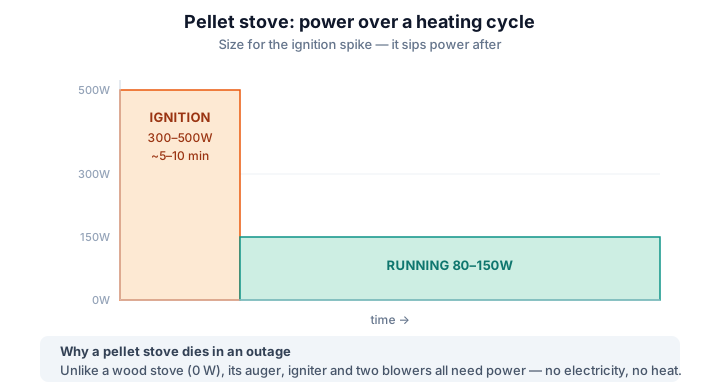
| Ignition (first ~5–10 min) | 300–500W | The igniter is the big draw; brief, then drops off |
| Running (steady burn) | 80–150W | Augers, blowers, and controls only — very low |
Figures are typical ranges from manufacturer specs and owner reports — your stove’s exact draw is on its rating label. The key takeaway: the ignition spike (300–500W) sets the minimum power station you need, but the running draw (80–150W) sets how long it lasts. Both are small by power-station standards.
The runtime formula
Usable runtime (hours) = (Battery Wh × 0.95 × 0.85) / Running watts

  0.95 = LiFePO4 usable-capacity factor
  0.85 = inverter conversion loss (AC output)
Worked examples for a 1,000Wh LiFePO4 station (≈808Wh usable):
- Efficient stove at 100W: 808 / 100 = ~8 hours continuous burn
- Higher-output stove at 150W: 808 / 150 = ~5.4 hours continuous burn
And a pellet stove cycles — it modulates down or idles once the room is warm — so real overnight coverage typically runs longer than these continuous figures. Run your own numbers with the Runtime Calculator.
Runtime by power station size
Estimated continuous burn time at two representative running draws, using the derating above. Real coverage is longer with cycling.
| Power station | Usable Wh | @ 100W | @ 150W |
|---|---|---|---|
| EcoFlow River 2 (256Wh) | ~207 | ~2 hr | ~1.4 hr |
| Bluetti AC180 (1,152Wh) | ~930 | ~9.3 hr | ~6.2 hr |
| EcoFlow Delta 2 (1,024Wh) | ~827 | ~8.3 hr | ~5.5 hr |
| Anker SOLIX C1000 (1,056Wh) | ~853 | ~8.5 hr | ~5.7 hr |
| Anker SOLIX F3800 (3,840Wh) | ~3,100 | ~31 hr | ~20.7 hr |
The takeaway: a ~1,000Wh unit covers a full night of heat for most pellet stoves, and a 3,000Wh+ unit with solar carries you through a multi-day winter outage.
Because a pellet stove is such a light load, most owners end up powering it alongside a fridge or a CPAP. The real-world runtime benchmarks table shows all seven appliance loads side by side across Bluetti, EcoFlow and Anker SOLIX, so you can add them up before you buy.
The two gotchas: ignition surge and pure sine wave
- Size for the ignition spike, not the running draw. The igniter pulls 300–500W at startup. That’s modest — any pure sine wave station rated 600W or more starts a pellet stove without trouble — but a tiny 300W unit may struggle on ignition even though it could easily handle the 100W running load afterward.
- Pure sine wave is required. A pellet stove’s control board and blower motors need a clean pure sine wave; a cheap modified-sine inverter can cause erratic behavior or damage the electronics. Every station recommended here is pure sine — never run a pellet stove from a modified-sine unit. (Same rule applies to a furnace.)
Most pellet stoves plug into a standard wall outlet, so you can simply plug the stove into the power station — no electrician or transfer switch needed, unlike a hardwired furnace.
Picks by scenario
Confirm your stove’s running and ignition watts on its label before buying.
Overnight backup, single stove → Bluetti AC180 / EcoFlow Delta 2 / Anker SOLIX C1000
A ~1,000Wh pure sine station runs a typical pellet stove 8–9 hours continuous — a full night with cycling — and clears the ignition spike easily. The AC180 (1,800W / 2,700W surge) is the affordable pick; the Delta 2 and C1000 add capacity and accept add-on batteries.
Lightest/budget option for an efficient stove → EcoFlow River 2
If your stove sips ~80–100W and you only need a few hours’ bridge, a compact 256Wh unit like the River 2 can cover short outages — though for a full night you’ll want a 1,000Wh-class station.
Multi-day winter outage → Anker SOLIX F3800 + solar
At 3,840Wh and expandable, the F3800 runs a pellet stove for a day-plus on battery alone and pairs with solar to recharge between cold nights — the configuration for riding out a multi-day winter outage while keeping the fridge and a few lights going too.
A note on the brands
The pure-sine stations here — EcoFlow, Bluetti, Anker SOLIX — are engineered in and around Shenzhen and publish detailed continuous and surge output specs. For a pellet stove the spec that matters is simply having a clean pure sine wave plus a little surge headroom over the 300–500W ignition draw — almost any quality 1,000Wh unit qualifies, so size for the runtime you want rather than worrying about whether it can start the stove.