
Pure Sine Wave Power Station: Why It Matters (2026)
Pure sine wave power stations vs modified sine wave inverters — device-by-device guidance for CPAP, fridges, and sensitive electronics.
TL;DR: A pure sine wave inverter outputs AC power that is functionally identical to the grid — a smooth sinusoid oscillating at 60Hz with less than 3% total harmonic distortion (THD). A modified sine wave (sometimes called “modified square wave”) inverter approximates that curve with a stepped, blocky waveform that can reach 35-45% THD. For resistive loads like incandescent bulbs or heating coils, the difference is invisible. For anything with a microprocessor, a brushless motor, a transformer, or a medical sensor — CPAP machines, oxygen concentrators, modern refrigerators, laser printers, variable-speed power tools — modified sine wave power causes overheating, audible buzzing, error codes, premature component failure, or outright refusal to start. Every reputable portable power station sold in 2024-2026 (Bluetti, EcoFlow, Anker SOLIX, Jackery’s higher tiers) uses pure sine wave inverters. The legacy “modified sine wave” hardware still sold cheap on Amazon should be treated as a fundamentally different product category.
This guide explains what the waveform actually is, why it matters at the circuit level, which device categories absolutely require pure sine wave power, which can tolerate modified sine wave in a pinch, and how to verify the inverter quality in any power station you’re considering buying.
For a complete troubleshooting guide covering all models, see our Common Bluetti Problems & Fixes (2026 Troubleshooting Guide).
What a Sine Wave Actually Is
Grid AC power in North America is a sinusoidal voltage that oscillates 60 times per second (60Hz) between approximately +170V peak and -170V peak. The RMS (root mean square) value of that waveform — the effective voltage your appliances “see” — is 120V. If you graph voltage on the Y-axis against time on the X-axis over a 16.67-millisecond cycle, you get a smooth, symmetrical curve crossing zero twice per cycle and reaching its peaks at the quarter and three-quarter points.
Picture a clean sine wave as a rolling ocean swell: continuous, predictable, with no sharp edges. Now picture a modified sine wave as a staircase of three flat plateaus per half-cycle — a positive plateau, a zero plateau, a negative plateau — repeating 60 times per second. From a distance the staircase has the same general shape, but viewed close up it is a series of abrupt voltage transitions with steep dV/dt slopes. Those transitions are the problem.
The “purity” of a sine wave is measured by Total Harmonic Distortion (THD). A perfect sine wave has 0% THD. Grid power in North America typically runs 2-5% THD. A high-quality portable power station inverter (Bluetti, EcoFlow, Anker SOLIX) is specified at less than 3% THD at rated load. A modified sine wave inverter runs 35-45% THD — meaning more than a third of the energy in the waveform is at frequencies other than the intended 60Hz fundamental.
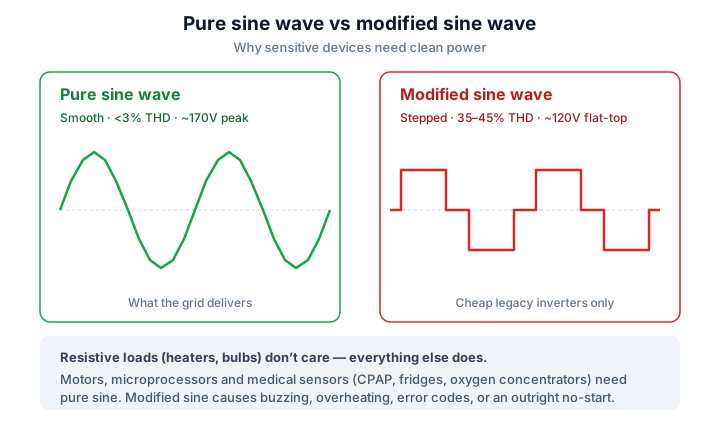
Why Harmonics Damage Electronics
Harmonic distortion is not just a number on a spec sheet — it represents real energy at frequencies (180Hz, 300Hz, 420Hz, and higher) that your devices were never designed to handle. Three specific failure modes are well-documented:
1. Transformer heating. Any device with a power transformer — older audio equipment, some medical devices, microwave ovens, halogen lamp drivers — converts harmonic content into heat in the transformer core through eddy currents and hysteresis losses. Run a microwave on modified sine wave power and it draws roughly 20% more current to deliver the same cooking power, the transformer runs 15-25°F hotter, and operating life can drop from 10 years to 3-4 years.
2. Motor inefficiency and overheating. AC induction motors (older refrigerators, fans, pumps) lose 10-20% efficiency on modified sine wave. The motor draws extra current trying to follow a distorted waveform, generates audible 120Hz buzz, and runs hot enough to trigger thermal cutoffs after 30-60 minutes of operation. Brushless DC motors with electronic commutation (modern refrigerator compressors, variable-speed tools) often refuse to start at all — the controller detects the abnormal input and faults out.
3. Switching power supply confusion. The switching power supply inside a laptop charger, a CPAP machine, an LED TV, or a phone charger samples the AC waveform at high speed to control its internal MOSFET switching. When that input is a stair-step rather than a smooth curve, the controller can mistime its switches, allowing current spikes that stress the input capacitors. Symptoms range from buzzing and reduced output to capacitor bulge after weeks of use to instant failure on devices that detect input quality (most CPAP machines).
Pure Sine Wave vs Modified: Side-by-Side
| Specification | Pure Sine Wave | Modified Sine Wave |
|---|---|---|
| Waveform shape | Smooth sinusoid | 3-step staircase |
| Typical THD | Less than 3% | 35-45% |
| Peak voltage | ~170V (matches grid) | ~120V flat-top |
| RMS voltage | 120V | ~108-115V (varies) |
| Frequency stability | ±0.1Hz | ±1-2Hz |
| Cost to manufacture | Higher (DSP + LC filter) | Lower (H-bridge only) |
| CPAP compatibility | Yes | No (most modern units) |
| Refrigerator compatibility | Yes | Conditional (older only) |
| Laser printer compatibility | Yes | No |
| Variable-speed tool compatibility | Yes | No |
| Incandescent bulbs | Yes | Yes |
| Resistive heaters | Yes | Yes |
The peak voltage difference matters more than most buyers realize. A modified sine wave inverter delivers a flat-topped waveform that peaks at roughly the RMS value (about 120V), while pure sine wave hits the same 170V peak as the grid. Devices with capacitor-input power supplies — almost everything modern — are designed to charge their input caps from those 170V peaks. Feed them flat-topped 120V peaks and the input capacitors never fully charge, the device runs in a brown-out state, and the regulator works harder to compensate.
Devices That REQUIRE Pure Sine Wave
The following device categories have documented failure modes on modified sine wave power. Use only a pure sine wave inverter:
Medical equipment. CPAP and BiPAP machines (ResMed AirSense 10/11, Philips DreamStation, Fisher & Paykel SleepStyle), portable oxygen concentrators (Inogen One G5, Caire FreeStyle Comfort), nebulizers, infusion pumps, sleep monitors. Modern CPAP machines actively monitor input waveform — the AirSense 11 will display “Power Supply Fault” within 60 seconds of being connected to a modified sine wave source. Oxygen concentrators with brushless compressor motors won’t start at all. For CPAP-specific runtime calculations and compatible units, see our best power station for CPAP guide.
Modern refrigerators and freezers. Any unit built after 2015 with an inverter compressor (LG Linear, Samsung Digital Inverter, GE variable-speed) requires pure sine wave. The variable-frequency drive in these compressors interprets harmonic distortion as line fault and refuses to start. Even older single-speed compressors run hotter and use more current.
Laser printers and copiers. The high-voltage fuser power supply inside a laser printer cannot regulate properly on stepped waveforms. Modified sine wave causes erratic print quality, ghosting, and frequent fuser failures (a $200-400 repair).
Brushless power tools. DeWalt FlexVolt chargers, Milwaukee M18 RapidCharge, Makita LXT rapid chargers. The fast-charge circuitry samples the AC waveform and faults out on modified sine wave. The 18650-cell battery chargers in many cordless tools display error codes immediately.
Variable-speed motors. Ceiling fans with electronic speed control, table saws with soft-start, blenders, electric mixers. Modified sine wave causes the motor to hunt for speed, vibrate, and overheat.
Audio equipment. Anything with a transformer or class-D amplifier. Modified sine wave produces audible 60Hz hum and 120Hz buzz in the output. Vinyl turntable preamps are especially sensitive.
Sensitive electronics with timers. Microwave ovens with digital displays, induction cooktops, modern coffee makers with capacitive touch panels. The microcontroller clock can drift or reset on harmonic-heavy power.
Devices That Can Tolerate Modified Sine Wave
A narrow category of resistive or simple inductive loads runs fine on modified sine wave inverters. If you already own a legacy modified sine wave inverter (common in older RVs and budget car inverters under $50), it’s still useful for:
- Incandescent light bulbs. Pure resistive load, indifferent to waveform.
- Resistive heaters. Space heaters, electric kettles, toasters, hair dryers without electronic controls.
- Older universal-motor tools. Corded drills, jigsaws, and circular saws from the pre-2010 era with brushed motors and no electronics. They’ll run with reduced torque and louder operation.
- Simple incandescent string lights. Christmas lights, work lights without LED converters.
- Old-school plug-in clocks with synchronous AC motors (though they’ll lose accuracy due to frequency drift).
If you can confirm a device has no microprocessor, no electronic speed control, no switching power supply, and no transformer, it will probably tolerate modified sine wave. Everything else: assume it requires pure sine wave.
How to Verify Pure Sine Wave in a Power Station You’re Buying
Every portable power station from a reputable brand released in 2020 or later uses a pure sine wave inverter. The question is verifying it. Three checks:
1. Spec sheet. Look for “Pure Sine Wave” explicitly stated under the AC Output section. The THD specification should be less than 3% or “under 3%” at full load. If the manufacturer lists THD as 5-10% or doesn’t list it at all, be suspicious. If the spec sheet says “Modified Sine Wave” — and a few sub-$200 Amazon units still do — skip it for any of the device categories listed above.
2. Oscilloscope test (if you own one). Plug the unit in, load it to 30-50% of rated output with a hair dryer or space heater on low, and probe the AC output with a 10x oscilloscope probe and a 100:1 differential probe (never probe AC mains directly with a single-ended probe — it’s a safety hazard). A pure sine wave looks like a textbook sinusoid. A modified sine wave looks like a staircase. Measure the THD with the scope’s FFT function if available.
3. The microwave test. A microwave oven is a sensitive load — it draws 700-1500W and has a transformer that responds audibly to harmonic distortion. Plug a microwave into the power station, set it to 50% power for 1 minute with a cup of water inside, and listen. On pure sine wave you’ll hear normal microwave operation: the fan, the magnetron click, the turntable. On modified sine wave you’ll hear a loud 120Hz buzz from the transformer, the cup of water will be barely warm after 60 seconds (the magnetron isn’t getting clean drive), and the unit’s case will feel warm. This test is non-destructive for 1-2 minutes but should not be repeated on modified sine wave inverters as a regular practice.
What “Pure Sine Wave” Actually Costs to Build
The reason cheap inverters still ship as modified sine wave is cost. A modified sine wave inverter is fundamentally an H-bridge of four MOSFETs switched on and off at 60Hz — the bill of materials is roughly $8-15 for a 1000W unit. A pure sine wave inverter requires a high-frequency PWM stage (typically 20-50kHz switching), a digital signal processor or microcontroller to shape the waveform, an LC output filter to smooth the PWM into a true sinusoid, and tighter tolerance on every component. BOM cost runs $35-70 for the same 1000W output. That cost difference cascades through the entire product: better capacitors, better thermal design, beefier transformers, more sophisticated firmware.
When you pay $999 for a Bluetti AC200P or $1099 for an Anker SOLIX C1000, a significant portion of the price difference vs a $200 Amazon-special “2000W inverter generator” is going into clean, regulated power output. The inverter quality is also what enables UPS-mode functionality — the ability to switch from grid to battery in 20ms or less without your computer rebooting requires a pure sine wave output that matches the grid waveform precisely at the moment of transition.
Inverter Specs Worth Reading
Beyond “Pure Sine Wave” itself, three specifications on a power station spec sheet matter for sensitive loads:
Continuous AC output (W). The wattage the inverter can sustain indefinitely. A CPAP draws 30-60W, but a refrigerator compressor draws 100-200W continuous after startup. Size the inverter for the continuous load plus 20% margin.
Surge output (W). The peak wattage the inverter can deliver for a few hundred milliseconds during motor starts. A typical refrigerator compressor surges to 3-5x its running wattage for the first 200-500ms of each start cycle. A 600W continuous inverter rated for 1200W surge can usually start a 150W refrigerator (which surges to 750W). The same inverter cannot start a 250W chest freezer (which surges to 1250W) — it’ll trigger overload protection.
Transfer time (ms) for UPS function. Lower is better for sensitive electronics. 30ms or less keeps desktop PCs and most home electronics running through a power cut. The EcoFlow Delta 2 specs under 30ms transfer, while the Anker SOLIX C1000 specs under 20ms — both are well within the range that keeps consumer PCs and home electronics running through a grid drop.
THD at full load. Some manufacturers spec THD at no-load (where it’s easy to achieve under 1%) but degrades to 5-8% at full load. Look for THD specs that explicitly state “at full load” or “at rated output.” Bluetti, EcoFlow, and Anker SOLIX all spec THD at rated load.
Common Mistakes Buyers Make
Assuming all “inverter generators” are pure sine wave. The Honda EU2200i, Yamaha EF2000iS, and Champion 2000W inverter generators are all true pure sine wave. But the term “inverter generator” sometimes gets misused on lower-tier gas units. Verify the spec sheet.
Trusting the price tag. A $150 “2000W inverter” on Amazon is almost certainly modified sine wave even if the listing photo shows a clean sine wave on a display screen. Pure sine wave at 2000W cannot be built at that price point in 2026.
Running a CPAP on a modified sine wave inverter “just for one night.” Modern CPAPs (ResMed AirSense 11, Philips DreamStation 2) will alarm and shut down within minutes. Older CPAPs may run but at reduced humidifier output. Either way, this is not a place to compromise — get a pure sine wave power station.
Ignoring the 12V DC output on a power station. Many devices (CPAPs included) can run from a power station’s 12V DC port using the manufacturer’s DC cable, bypassing the AC inverter entirely. This is more efficient (no inverter losses, typically 8-12% savings) and sidesteps the sine wave question entirely. For CPAP overnight use, the 12V DC route stretches a 1000Wh power station from 18 hours to 22-24 hours of CPAP runtime.
The Bottom Line
In 2026, “pure sine wave” should be table-stakes for any portable power station you’d consider for emergency backup, off-grid living, RV use, or medical equipment. Every unit from Bluetti, EcoFlow, Anker SOLIX, Jackery (Explorer 500 and up), Goal Zero, Oupes, and AllPowers ships with pure sine wave AC output specified at less than 3% THD. The legacy modified sine wave market still exists for budget car inverters and certain industrial applications, but it has no place in a primary backup power system.
When evaluating a power station, confirm three things on the spec sheet: pure sine wave AC output, THD less than 3% at rated load, and transfer time under 30ms if you’ll use it as a UPS (under 20ms is even better for sensitive desktop PCs). Everything else — capacity, charging speed, port selection, app integration — is secondary to having clean power. A CPAP machine that won’t start, a refrigerator that won’t run, or a laptop that won’t charge from your $1000 power station is a power station that failed at its core job.