
How to Choose a Portable Power Station 2026 (Buying Guide)
Buying framework for portable power stations in 2026: wattage math, capacity sizing, chemistry choice, and brand reliability tradeoffs.
TL;DR: Choosing a portable power station in 2026 comes down to six numbers and four decisions. The six numbers: total continuous wattage of your loads, surge wattage of your largest motor, runtime hours you need, daily watt-hour consumption, solar input you can realistically deploy, and the unit’s cycle life at 80% depth of discharge. The four decisions: LiFePO4 vs NMC chemistry, pure sine vs modified sine inverter, fixed vs expandable capacity, and brand reliability vs price. Get these right and the “best” unit picks itself. Get them wrong and you’ll either overpay for capacity you never use or stall halfway through a power outage with a unit that can’t start your fridge.
This guide is structured as a framework, not a product roundup. We walk you through the math first, then map the math onto five honest use-case archetypes (CPAP, weekend camping, RV boondocking, home backup, off-grid cabin), and finally show which 2026 units fit each archetype with their actual tradeoffs — not their marketing copy.
For a complete troubleshooting guide covering all models, see our Common Bluetti Problems & Fixes (2026 Troubleshooting Guide).
Want to calculate this for your exact setup? Use our Runtime Calculator — it accounts for real-world losses.
Want to calculate this for your exact setup? Use our Solar charge time calculator — it accounts for real-world losses.
Step 1: Calculate Your Continuous Wattage Load
The single most common buying mistake is underestimating continuous wattage. People look at a 1500W inverter rating and assume it covers “everything.” It doesn’t. Add up the wattage of every device you’d run simultaneously and add a 20% buffer.
Real numbers from typical loads:
- CPAP machine (no humidifier): 30-40W
- CPAP with humidifier on: 60-90W
- Mini-fridge (12V or 120V compressor): 45-90W running, 200-400W startup surge
- Full-size refrigerator: 100-200W running, 600-1200W startup surge
- Microwave (rated 1000W cooking power): 1500-1800W actual draw
- Coffee maker (drip): 900-1200W
- Electric kettle: 1500W
- Space heater (low setting): 750W
- Space heater (high): 1500W
- Hair dryer: 1200-1875W
- Power tools (circular saw): 1400W running, 2300W surge
- TV (55-inch LED): 60-100W
- Laptop charger: 45-100W
- LED light strip: 5-20W
If you run a 90W CPAP, a 60W laptop, and a 100W mini-fridge simultaneously, your continuous load is 250W — but the fridge compressor surge can briefly hit 600W. You need an inverter rated for at least 600W surge and 300W continuous (with the 20% buffer). A 1000W unit handles this comfortably. A 300W unit will fault on the fridge startup.
For starting motors (fridges, well pumps, air conditioners, power tools), check the surge rating on the unit’s spec sheet, not the continuous rating. Most reputable 2026 units list both. Ignore brands that only publish one number — they’re hiding something.
Step 2: Calculate Your Watt-Hour Capacity Needs
Capacity (measured in watt-hours, Wh) is the fuel tank. Wattage is how fast you can pour fuel out. They are independent specs.
The formula: Capacity needed (Wh) = (Average watts × hours of use) ÷ 0.85
The 0.85 accounts for inverter efficiency losses (typically 10-15% on AC output) plus a small reserve so you don’t deep-cycle to 0% every time, which kills any chemistry faster.
Worked examples:
CPAP overnight (8 hours, 60W average): (60 × 8) ÷ 0.85 = 565 Wh A 700-1000 Wh unit covers one night with margin. A 500 Wh unit cuts it very close, especially in cold weather where battery capacity drops 15-30%.
Weekend camping (2 days, no solar):
- LED lights: 15W × 5h = 75 Wh
- Phone charging × 3: 30 Wh
- 12V cooler: 50W × 24h × 0.5 duty cycle = 600 Wh
- Laptop work: 60W × 4h = 240 Wh
- Daily total: ~945 Wh
- Two days: 1890 Wh ÷ 0.85 = ~2200 Wh needed A 2000-2400 Wh unit works. Add a 200W solar panel and you can stretch a 1000 Wh unit to the same trip.
Power outage backup (essentials only, 24 hours):
- Full fridge: 100W average × 24h × 0.4 duty cycle = 960 Wh
- LED lighting: 30W × 6h = 180 Wh
- Phones, router, modem: 50W × 24h = 1200 Wh
- Occasional microwave use: 1500W × 0.2h = 300 Wh
- Total: ~2640 Wh ÷ 0.85 = ~3100 Wh A 3000-3600 Wh unit handles one day. For multi-day outages, you need expandability or solar.
If your math lands above 2500 Wh and you might face multi-day events, prioritize expandable capacity over a single large unit. Hauling a 90-pound brick isn’t fun.
Shortcut: Skip the manual math — our Power Station Size Calculator does all of this for you, including inverter losses, battery chemistry, and a 20% headroom buffer.
Quick-sizing reference by use case
| Use case | Typical load | Runtime needed | Recommended capacity |
|---|---|---|---|
| CPAP (no humidifier) | 30–60W | 8h (1 night) | 500–700 Wh |
| CPAP (with humidifier) | 60–90W | 8h (1 night) | 700–1,000 Wh |
| Weekend camping (2 days) | ~400W daily | 48h | 1,800–2,400 Wh |
| Fridge backup (1 day) | 100W avg | 24h | 2,500–3,200 Wh |
| Home essentials (1 day) | 200–300W avg | 24h | 3,000–3,600 Wh |
| Laptop + router (8h work) | 100–150W | 8h | 1,000–1,500 Wh |
| Off-grid solar + lights | 50–100W daily | Ongoing w/ 200W panel | 1,000–2,000 Wh |
Step 3: Choose Your Battery Chemistry
In 2026 there are two chemistries worth considering: LiFePO4 (lithium iron phosphate, abbreviated LFP) and NMC (nickel manganese cobalt, often marketed as “lithium-ion” without further specification). The choice is not subtle.
LiFePO4 advantages:
- 3000-3500 cycle life to 80% capacity (vs. 500-1000 for NMC)
- Thermal stability — much harder to ignite or thermal-run away
- Wider safe operating temperature on discharge (-4°F to 140°F typical)
- No noticeable capacity fade for the first 1500 cycles in most units
LiFePO4 disadvantages:
- Heavier (about 30-40% more weight per Wh than NMC)
- Lower charging efficiency below 32°F (some units block charging below freezing)
- Slightly lower energy density means physically larger units
NMC advantages:
- Lighter and more compact (better for backpacking-style units under 500 Wh)
- Sometimes cheaper upfront
NMC disadvantages:
- Shorter cycle life — a 1000-cycle NMC unit cycled daily lasts under 3 years
- Higher thermal risk if punctured, overcharged, or used at elevated temperatures
- Capacity fade is gradual but continuous from day one
For 90% of buyers in 2026, LiFePO4 is the correct answer. The weight penalty is real but the cycle life math is overwhelming: a $1000 LiFePO4 unit good for 3000+ cycles costs roughly $0.33 per cycle. A $700 NMC unit good for 800 cycles costs $0.88 per cycle. Over the life of the battery, NMC is more expensive per kWh delivered.
The only honest case for NMC in 2026 is when total weight under 12 pounds matters more than longevity — small overlanding or backpacking units in the 200-500 Wh range. For a deeper breakdown, see our LiFePO4 vs lithium-ion comparison.
Step 4: Demand a Pure Sine Wave Inverter
Every power station marketed for home backup or sensitive electronics in 2026 should ship with a pure sine wave inverter. If the spec sheet says “modified sine,” “quasi-sine,” or doesn’t specify, walk away.
Why this matters in real numbers:
- Pure sine: harmonic distortion under 3%
- Modified sine: harmonic distortion 20-40%
Modified sine causes audible buzz in fans, premature failure of brushless DC motors (fridges, fans, pumps), erratic behavior in CPAPs and medical equipment, and refusal to run by most newer LED dimmers and induction-based devices. Laser printers, microwaves, and variable-speed tools may also misbehave or refuse to start.
The cost difference between modified sine and pure sine units in 2026 is small — usually $50-100 at the same capacity. There’s no good reason to save the money.
Also check for low THD (total harmonic distortion) below 3% if you plan to run a CPAP, oxygen concentrator, or sensitive lab equipment. Cheap pure sine inverters sometimes drift up to 5-8% THD under load, which is still safer than modified sine but can trigger fault codes on medical gear.
Step 5: Decide on Expandability
The 2026 market has split into three architectures:
- Fixed capacity — sealed unit, what you buy is what you get. Examples: Jackery 1000 v2, EcoFlow River 2 Max.
- Expandable via external batteries — host unit accepts add-on battery packs over a proprietary connector. Examples: Bluetti AC200P + B230, Bluetti AC300 + B300, EcoFlow Delta Pro + extra battery, Anker Solix F2000 + expansion.
- Modular dual-voltage systems — high-voltage hub plus stackable batteries. Examples: Bluetti AC500/AC300 platform, EcoFlow Delta Pro Ultra.
Expandable units cost 20-40% more upfront than equivalent fixed units, but the payoff is significant if your needs grow. You can start with 2000 Wh, then add a 2000 Wh expansion battery during the next outage season for 4000 Wh total without buying a second base unit.
The honest tradeoff: expandable systems lock you into a brand ecosystem. Bluetti expansion batteries don’t talk to EcoFlow units. Anker’s expansion architecture is proprietary. Choose your brand carefully if you plan to expand, because switching later means selling both pieces and starting over.
Step 6: Solar Input — What’s Actually Realistic
Solar input ratings on power stations are best-case lab numbers. Real-world solar harvest is 60-75% of rated input on a clear summer day, 30-50% in winter or partial cloud.
Key specs to verify:
- Maximum PV input wattage (e.g., 500W, 1200W, 1800W)
- Voltage range (e.g., 12-60V or 12-150V) — wider is better for series wiring
- MPPT vs PWM — must be MPPT for any unit over 300W; PWM wastes 20-30% of available power
- Connector type — typically XT60 or proprietary; verify panel compatibility
If your unit accepts 12-60V and you wire two 24V (open-circuit ~22V each) panels in series, you’ll exceed 44V and may damage the MPPT. Read voltage limits, not just wattage limits. Our solar panel compatibility guide walks through this in detail.
For practical sizing: a 400W panel array on a power station rated 500W solar input will, on a clear summer day, harvest about 1500-2200 Wh over 6-8 productive sun hours. That’s enough to refill a 2000 Wh unit in one day with no other loads. Add normal daytime loads and harvest drops to 1000-1500 Wh net.
If you plan to live off solar for more than a long weekend, oversize your solar by 30-50% beyond your daily Wh consumption. A 2000 Wh per day budget needs 600-800W of panels in real conditions, not 300W.
Step 7: Brand Reliability — The Honest Tradeoffs
Brand reputation in 2026 matters more than ever because the market has flooded with rebranded white-label units that share components but vary wildly in firmware quality, BMS tuning, and warranty enforcement. Here’s what we’ve seen from years of reader correspondence and teardown analysis:
Bluetti — Solid LFP units, excellent expandability ecosystem (AC200P, AC300, AC500). Firmware updates over Bluetooth are reliable. Warranty service has improved significantly since 2024 but US returns can still take 4-6 weeks. App is functional, not polished. Older models like the AC200P remain serviceable and parts-available.
EcoFlow — Best-in-class fast charging (some units hit 80% in 50 minutes) and app experience. LFP across the Delta 2 / Delta Pro line and the new RIVER 3 series (2026). The RIVER 3 and RIVER 3 Plus are notable 2026 additions — compact LFP units with 100W USB-C PD and competitive pricing in the 300-400 Wh class. Some users report fan noise issues at high charge rates. Warranty handling is responsive in North America. Be aware of error codes like Error 022 on the Delta 2 — we cover that in our EcoFlow Delta 2 Error 022 guide. We personally handled the RIVER 3 and documented the experience in our EcoFlow RIVER 3 review.
Anker Solix — Strong build quality, premium pricing, conservative BMS tuning means rated capacity is often delivered fully (no inflated marketing numbers). LFP on all C-series and F-series. Warranty service in the US is the most consistent of the four. Solix F3800 is the standout for home backup if budget allows.
Jackery — Historically NMC-heavy, slowly transitioning the lineup to LFP through 2025-2026. Earlier units have shorter cycle life by design. Excellent customer service and the cleanest UI on smaller units. Pricing tends to be 10-20% higher than comparable Bluetti/EcoFlow units at the same capacity.
Oupes, Allpowers, Growatt, Dabbsson — Value-tier brands with LFP at lower prices. Build quality varies more unit-to-unit. Warranty enforcement is more variable. Reasonable choices for budget builds if you accept slightly higher risk of needing self-service troubleshooting.
The honest rule: pay 15-25% more for a tier-1 brand if this is your primary backup for a fridge, CPAP, or medical equipment. Pay less for a tier-2 brand if this is a secondary camping unit and downtime isn’t critical.
Step 8: Charging Options Matter Too
A unit that takes 8 hours to recharge from a wall outlet is a problem during a storm where utility power flickers in and out. Check three numbers:
- AC input wattage — modern 2026 units in the 1000-2000 Wh class should accept 1000W+ AC input, refilling in 1.5-3 hours
- 12V car input — typically 100-200W, useful for road trips but slow for primary charging
- Solar input — covered above
Some units offer dual charging (AC + solar simultaneously), which is genuinely useful during outages — plug into a neighbor’s generator while solar trickles in.
Avoid units that throttle AC input when the battery is above 80%. Some brands cut input to 200-300W in the final 20%, doubling total recharge time. The spec sheet won’t always disclose this — check teardown videos or reader reviews.
Use-Case Decision Matrix
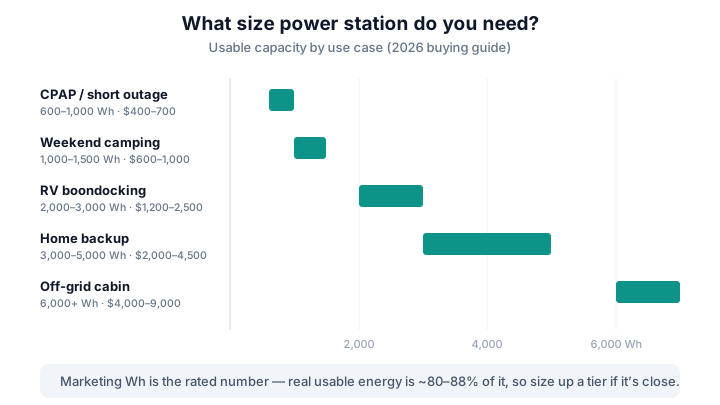
Here are the five archetypes mapped onto specific 2026 recommendations:
Archetype 1: CPAP user, occasional outages (under 24 hours)
- Needs: 600-1000 Wh, 300W+ pure sine inverter, LFP, quiet operation
- Target spend: $400-700
- Good fit: EcoFlow River 2 Max, Bluetti EB70, Anker Solix C800, EcoFlow RIVER 3 (348 Wh, compact LFP)
- Skip: Anything under 500 Wh (no margin for cold-weather capacity loss)
Archetype 2: Weekend campers, no critical loads
- Needs: 1000-1500 Wh, 1000W inverter, LFP, lightweight if possible
- Target spend: $600-1000
- Good fit: EcoFlow Delta 2, Anker Solix C1000, Bluetti AC180, EcoFlow RIVER 3 Plus (416 Wh with more ports)
- Add: 200W folding solar panel for trips over 2 nights
Archetype 3: RV boondocking, multi-day
- Needs: 2000-3000 Wh, 2000W inverter, expandability, MPPT 500W+
- Target spend: $1200-2500
- Good fit: Bluetti AC200P (expandable to 8000+ Wh), Anker Solix F2000, EcoFlow Delta Max
- Add: 400-600W solar array
Archetype 4: Home backup for essentials (fridge, lights, comms)
- Needs: 3000-5000 Wh, 3000W+ inverter, LFP, expandable, fast AC recharge
- Target spend: $2000-4500
- Good fit: Bluetti AC300 + B300 battery, Anker Solix F3800, EcoFlow Delta Pro
- Add: Generator-compatible AC input, transfer switch for whole-circuit feeding
Archetype 5: Off-grid cabin, primary power source
- Needs: 6000+ Wh, 3600W+ inverter, modular expansion, robust MPPT for 1500W+ solar
- Target spend: $4000-9000
- Good fit: Bluetti AC500 + B300S stack, EcoFlow Delta Pro Ultra, Anker Solix F3800 with expansion
- Add: Permanent panel array, hardwired transfer switch
Common Buying Mistakes to Avoid
After reviewing hundreds of reader buying questions, these are the patterns that come up again and again:
- Buying for peak load instead of typical load. You probably don’t run a 1500W kettle and 1800W microwave simultaneously. Size for sustained use, not a once-a-month edge case.
- Ignoring weight. A 100-pound unit that lives in your garage is fine. A 100-pound unit you wanted for tailgating is a regret.
- Trusting the marketing capacity number. Marketing watt-hours assume ideal conditions. Real usable capacity after inverter losses and BMS reserve is typically 80-88% of rated.
- Skipping the surge spec. A 1000W inverter with 1500W surge will fault on a fridge startup that hits 1800W. Surge rating is non-negotiable for motor loads.
- Buying generic solar panels without checking voltage. Most failures we troubleshoot are voltage mismatches, not faulty panels.
- Assuming all “lithium” units are LiFePO4. Read the spec sheet. If chemistry isn’t explicitly listed, assume it’s NMC.
- Stacking too many expansions without checking inverter capacity. Adding battery doesn’t add inverter wattage. Your 1800W inverter is still 1800W with 8000 Wh attached.
- Forgetting about firmware updates. Some units fix major bugs (charging, fan curves, error code handling) post-launch. Always update before first heavy use.
When DIY Isn’t Worth It
A portable power station is a sealed product. Unless you’re trading warranty for a custom battery swap and you have prior experience with BMS-managed LFP packs, opening the unit voids coverage and creates real fire risk. For units under warranty showing battery degradation, charging failures, or inverter faults: file the claim. Bluetti, EcoFlow, and Anker all replace units within warranty for verified defects. Out-of-warranty service is rarely cost-effective above 3 years old — at that point a replacement with current LFP cycle life is usually the better economic choice.
Final Buying Checklist
Before clicking buy, verify each of these from the official spec sheet (not marketing pages):
- Battery chemistry explicitly listed as LiFePO4 (LFP)
- Continuous inverter wattage covers your simultaneous loads with 20% margin
- Surge wattage covers your largest motor startup
- Pure sine wave inverter, THD under 5%
- Usable capacity (Wh) meets your daily budget calculation
- AC recharge time under 3 hours for the rated capacity
- Solar input voltage range matches your planned panel configuration
- MPPT (not PWM) on the solar controller
- Expandable if your needs may grow within 2-3 years
- Warranty 3 years minimum (5 years for LFP units is now common)
- Brand has a verifiable North American RMA process
- Cycle life rated at 80% capacity retention, not 50%
If all 12 boxes check on a unit within your budget archetype, buy it. If two or more are unclear or missing from the spec sheet, that’s a signal to look elsewhere.