
LiFePO4 vs Lithium-Ion Power Stations: What Actually Matters
Honest comparison of LiFePO4 vs lithium-ion (NMC) batteries in power stations — cycle life, usable depth, safety, weight, cold weather, and price.
If you’re shopping for a portable power station in 2026, every product page boasts about LiFePO4 (lithium iron phosphate) chemistry as if it’s a magical upgrade. The marketing is broadly correct but missing context — there are five genuine differences between LiFePO4 and traditional lithium-ion (NMC), and only three of them probably matter for your specific use case.
This guide explains each difference in plain terms, says when each chemistry is actually better, and helps you decide whether the LiFePO4 premium is worth paying.
The five differences that actually matter
- Cycle life — LiFePO4 lasts 3-5× longer
- Usable depth-of-discharge — LiFePO4 gives you ~19% more usable energy
- Thermal safety — LiFePO4 doesn’t catch fire under abuse
- Energy density — Lithium-ion is lighter for the same Wh
- Cold weather — Both lose capacity but in different ways
Two more often-cited differences that don’t matter for portable power stations:
- Cell voltage (3.2V vs 3.7V) — invisible to the user
- Self-discharge rate — both are negligible
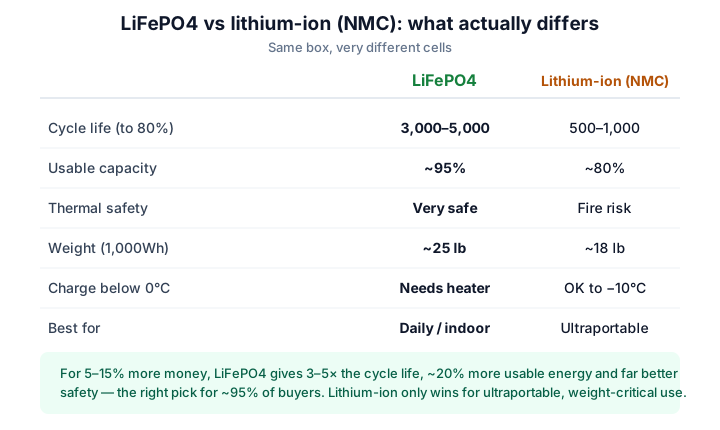
Difference 1: Cycle life
A “cycle” is one full discharge from 100% to 0% (or two half-discharges, etc.). After a certain number of cycles, any battery degrades — its capacity falls to a percentage of its original rating.
| Chemistry | Cycles to 80% capacity | Cycles to 50% capacity |
|---|---|---|
| LiFePO4 | 3,000-5,000 | 8,000-10,000 |
| Lithium-ion (NMC) | 500-1,000 | 1,500-2,500 |
Translation: a LiFePO4 unit cycled daily lasts 8-14 years before noticeable degradation. A lithium-ion unit lasts 1.5-3 years.
Does it matter for you?
- ✅ Daily user (full-time off-grid, daily RV, daily home backup): cycle life is critical
- ⚠️ Weekly user (weekend camping, monthly testing): you’ll replace the unit for other reasons before cycle life matters
- ❌ Annual user (emergency backup only): cycle life is irrelevant — calendar aging hits both chemistries similarly
Difference 2: Usable depth-of-discharge
Both chemistries are rated by total Wh, but you can’t actually use 100% of that:
| Chemistry | Safe discharge depth | Effective usable capacity |
|---|---|---|
| LiFePO4 | 95-100% | 95% of rated Wh |
| Lithium-ion (NMC) | 70-80% | 80% of rated Wh |
A “1,000Wh” LiFePO4 unit gives you ~950Wh usable. A “1,000Wh” lithium-ion unit gives you ~800Wh — 150Wh less.
Practical impact: this is bigger than people realize. The advertised “Bluetti AC200P 2000Wh” (lithium-ion) provides about 1,600Wh of actually usable energy. A “Bluetti AC200MAX 2,048Wh” (LiFePO4) provides about 1,946Wh. The MAX has 22% more usable energy despite only 2.4% more rated capacity.
Difference 3: Thermal safety
LiFePO4 has fundamentally different chemistry that makes it dramatically harder to enter thermal runaway:
| Failure mode | LiFePO4 | Lithium-ion (NMC) |
|---|---|---|
| Puncture | Rarely leads to thermal runaway; vents gas | Significant fire risk; can ignite |
| Overcharge to 200% rated voltage | Heats up; cells fail safe | Thermal runaway likely |
| Short circuit | BMS trips; cells unharmed | BMS trips; cells may still cascade |
| House fire heating cells to 200°C | Slowly vents and degrades | Explodes |
Practical impact:
- Indoor home backup: LiFePO4 is essentially required for safety
- Vehicle / RV use: LiFePO4 is strongly preferred (cars catch fire, you don’t want lithium-ion ferrying that)
- Outdoor portable: less critical but still relevant in tents or near gas equipment
The few documented portable power station fires from 2020-2025 have almost all been lithium-ion units. LiFePO4 power station fires are vanishingly rare.
Difference 4: Energy density (weight)
The trade-off for LiFePO4’s safety and cycle life: it’s heavier for the same capacity.
| Capacity | LiFePO4 weight | Lithium-ion weight |
|---|---|---|
| 500Wh | ~12 lbs / 5.4kg | ~9 lbs / 4kg |
| 1,000Wh | ~25 lbs / 11kg | ~18 lbs / 8kg |
| 2,000Wh | ~50 lbs / 23kg | ~37 lbs / 17kg |
| 3,800Wh | ~95 lbs / 43kg | ~70 lbs / 32kg |
Practical impact:
- Backpacking: weight matters; lithium-ion is more practical
- Car camping / RV: weight is acceptable; LiFePO4 is the choice
- Home backup: weight is irrelevant; LiFePO4 dominates
For most of us, the weight penalty is a non-issue. We’re not carrying these units more than 20 feet from car to campsite.
Difference 5: Cold weather
Both chemistries lose performance in the cold, but in different ways:
LiFePO4 cold behavior:
- Discharge: works down to -20°C with reduced capacity
- Charge: cannot be safely charged below 0°C — most modern LiFePO4 power stations include internal heaters
- Practical: keep the unit above freezing; heated battery models work down to -10°C ambient
Lithium-ion cold behavior:
- Discharge: works down to -10°C with reduced capacity
- Charge: can be charged down to -10°C (slower)
- Practical: more forgiving in cold but lower base performance
Real-world winner: depends on whether your LiFePO4 unit has an internal heater. Modern Bluetti / EcoFlow / Anker SOLIX units do. Older or budget units may not — check spec sheets carefully if you camp below freezing.
Cost comparison
As of mid-2026, the LiFePO4 premium has nearly disappeared:
| Capacity | LiFePO4 typical price | Lithium-ion typical price |
|---|---|---|
| 1,000Wh | $700-900 | $600-800 |
| 2,000Wh | $1,300-1,800 | $1,200-1,600 |
For 5-15% more money, you get 3-5× more cycle life, ~20% more usable energy, and far better safety. LiFePO4 is the rational choice for almost any new purchase in 2026.
The only exception: ultraportable backpacking units under 500Wh, where lithium-ion’s weight advantage is meaningful and the limited cycle life isn’t (you cycle these maybe 20-30 times per year of camping).
So which should you buy?
Are you cycling daily?
├── Yes → LiFePO4 (cycle life dominates economics)
└── No →
    Will you store indoors?
    ├── Yes → LiFePO4 (safety)
    └── No →
        Is weight critical (carrying > 100m)?
        ├── Yes → Lithium-ion (acceptable trade-off)
        └── No → LiFePO4
For 95% of buyers, the answer is LiFePO4. The remaining 5% are backpackers and people buying cheap-as-possible emergency units.
Models by chemistry (quick reference)
LiFePO4 (recommended):
- Bluetti AC180, AC200MAX, AC300, Elite 200 V2, AC500
- EcoFlow Delta 2, Delta 2 Max, Delta Pro, Delta Pro Ultra, River 2 series
- Anker SOLIX C300, C800, C1000, F2000, F3800
- Jackery Explorer Pro series (Explorer 1000 V2, 1500 V2, 2000 V2 onwards)
Lithium-ion (older / budget):
- Bluetti AC200P, EB70, EB150, EB240
- Jackery Explorer 240, 300, 500, 1000 (original)
- Goal Zero Yeti 200X, 500X, 1500X
If you’re cross-shopping a newer LiFePO4 unit against an older lithium-ion unit at a similar price, the LiFePO4 unit is essentially always the better long-term value.
What chemistry doesn’t change
A common misconception: LiFePO4 is “safer” so it must be more rugged in every way. It’s not.
- Drop resistance: identical (depends on case design)
- Water resistance: identical (depends on enclosure)
- Outdoor temperature limits: nearly identical
- Charging speed: identical at the inverter level
- Inverter quality: independent of cell chemistry
- App / UX: independent of cell chemistry
The chemistry affects the cells inside the box. Everything else is design — and a poorly-designed LiFePO4 unit can still feel cheap, run hot, have buggy firmware, etc. Don’t assume LiFePO4 = better product overall. Check reviews of the specific unit.