
Solar Panel Compatibility: Which Panels Actually Work
Check your station's solar input voltage window first — most "incompatible" panels fail here. MC4 vs XT60, series vs parallel, plus a lookup table.
Power station manufacturers want you to buy their branded solar panels — they’re expensive, often badged versions of generic panels with a 50-100% markup. But here’s the truth: almost any modern solar panel works with almost any modern power station, provided you understand three numbers and use the right adapter cable.
This guide walks through the three numbers, the adapter situation, and which specific third-party panels are worth your money.
The three numbers that matter
Every solar panel has three published specs that determine compatibility:
- Voc (open-circuit voltage) — the maximum voltage the panel produces with no load. Must stay below your power station’s MPPT maximum.
- Vmp (maximum power voltage) — the voltage at which the panel produces peak power under load. Must stay above your power station’s MPPT minimum.
- Rated wattage (W) — peak power output under ideal conditions. Sum of all connected panels must stay below your power station’s solar input limit.
You can almost always find these on the back label of the panel, or on the spec sheet PDF.
Power station MPPT input windows (most common models)
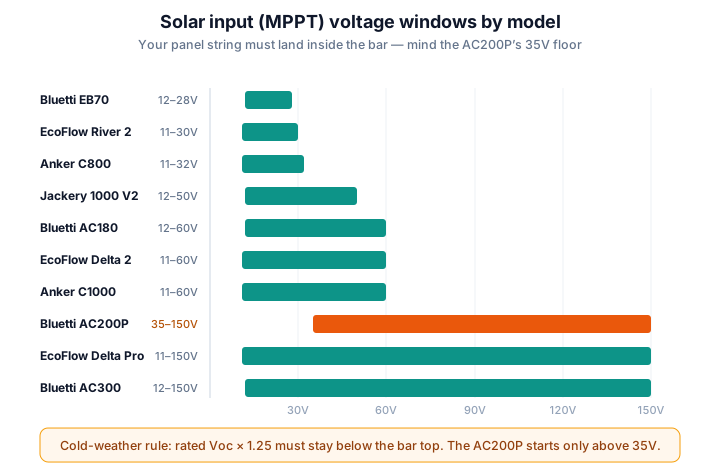
| Brand | Model | Voltage range | Max wattage | Connector |
|---|---|---|---|---|
| Bluetti | AC200P | 35-150V | 700W | Aviation 7-pin (MC4 adapter in box) |
| Bluetti | AC200MAX | 12-145V | 900W | Aviation 7-pin (MC4 adapter in box) |
| Bluetti | AC300 | 12-150V | 2,400W combined | Aviation 7-pin |
| Bluetti | AC180 | 12-60V | 500W | XT60 |
| Bluetti | EB70 | 12-28V | 200W | MC4 |
| EcoFlow | Delta 2 | 11-60V | 500W | XT60 |
| EcoFlow | Delta 2 Max | 11-60V | 1,000W | XT60 |
| EcoFlow | Delta Pro | 11-150V | 1,600W | XT150 (Anderson) |
| EcoFlow | River 2 | 11-30V | 110W | XT60 |
| Anker SOLIX | C300 | 11-32V | 100W | XT60 |
| Anker SOLIX | C800 | 11-32V | 300W | XT60 |
| Anker SOLIX | C1000 | 11-60V | 600W | XT60 |
| Anker SOLIX | F2000 | 11-60V | 1,000W | XT60 |
| Anker SOLIX | F3800 | 11-60V / 12-150V | 2,400W combined | XT60 |
| Jackery | Explorer 1000 V2 | 12-50V | 400W | DC8020 |
| Jackery | Explorer 2000 Plus | 11-60V | 1,400W | MC4 |
The connector situation (and why it doesn’t really matter)
Despite the table showing different connectors per brand, almost all third-party solar panels use MC4 connectors as standard. The adapter situation is:
- MC4 → Aviation 7-pin: Adapter included in box (Bluetti AC200P / AC200MAX / AC300)
- MC4 → XT60: $15 adapter cable (EcoFlow Delta 2 / Max, Bluetti AC180, Anker SOLIX, Jackery Explorer V2)
- MC4 → XT150 / Anderson: $20 adapter (EcoFlow Delta Pro, Goal Zero, some older models)
- MC4 → DC8020: $20 adapter (older Jackery)
A single MC4 → XT60 cable lets you use any standard panel with your EcoFlow or Anker. The adapter doesn’t reduce performance.
Series vs parallel wiring
Two panels can be wired together two ways:
Series (most common)
- Voltage adds; current stays the same
- Two 100W panels at 20Voc each → 40Voc combined
- Good for: power stations with high voltage MPPT range
- Risk: cold-weather Voc spike can exceed your MPPT max
Parallel
- Current adds; voltage stays the same
- Two 100W panels at 20Voc each → still 20Voc combined
- Good for: power stations with low voltage MPPT range or short cable runs
- Required hardware: a Y-branch MC4 splitter ($10)
Which to use
Power station MPPT max ≥ 100V → use SERIES (more efficient, longer cable runs OK)
Power station MPPT max < 60V  → use PARALLEL (avoids cold-weather Voc spike)
Mixed array (different panels) → use parallel ONLY (series with mismatched panels wastes power)
For the most common case — a Bluetti AC200P or AC200MAX with two identical 200W panels — series is the right choice.
Cold-weather Voc spike (the gotcha)
Panel Voc is rated at 25°C. In cold weather, Voc rises by ~0.4% per °C below 25°C. A panel rated 22Voc at 25°C produces 24.6Voc at -5°C.
For a four-panel series string of 22Voc panels (88Voc total at 25°C), the cold-weather peak is ~98Voc — fine for a 150V MPPT, but dangerous for a 60V MPPT which would lock out.
Rule of thumb: multiply your panel’s Voc by 1.25 to get the cold-weather max. Confirm this stays below your power station’s MPPT ceiling.
Recommended third-party panels by power station
For Bluetti AC200P / AC200MAX / AC300 (35-150V MPPT)
- Renogy 200W 12V Monocrystalline — two in series = 44Voc, 400W. Sweet spot.
- Rich Solar 200W — same idea, slightly different price
- BougeRV 200W Yuma Series — flexible panel for curved RV roofs
Planning a large array and deciding between the AC300’s dual-MPPT input and EcoFlow’s 1,600W Delta Pro? Our EcoFlow Delta Pro vs Bluetti AC300 comparison puts the two side by side, solar input included.
For Bluetti AC180 / AC200MAX PV1 (12-60V MPPT)
- Renogy 100W 12V Monocrystalline — single panel = 22Voc, 100W
- Two in parallel with MC4 Y-branch = 22Voc, 200W (recommended for AC180)
For EcoFlow Delta 2 / Delta 2 Max (11-60V MPPT)
- Renogy 200W 12V Monocrystalline + MC4-to-XT60 adapter — ~22Voc, 200W
- EcoFlow 220W folding — branded but actually quite portable
- Two Renogy 100W in parallel + MC4-to-XT60 adapter — same wattage as one 200W, easier to transport
For Anker SOLIX C800 / C1000 (11-32V / 11-60V MPPT)
- Renogy 200W 12V + MC4-to-XT60 adapter — works on both
- BougeRV 200W foldable — popular for car camping
For high-voltage MPPT systems (Bluetti AC500, Delta Pro Ultra)
- REC Alpha or LG NeON R 60-cell panels — 40Voc each, three in series = 120Voc, 900-1080W. Roof-mount territory.
- Generally these systems are for fixed installations, not portable use.
Foldable / portable panels vs rigid panels
| Type | Pros | Cons |
|---|---|---|
| Foldable monocrystalline | Carry in suitcase; deploys in 60 seconds; good for travel | Higher cost per watt; rated current sometimes 15% below glass panels |
| Rigid glass panels | Lower cost per watt; longest lifespan (25+ years); higher efficiency | Heavy; hard to transport; need fixed mounting |
| Flexible thin-film | Bend over curved RV roofs; very light | Lower efficiency; shorter lifespan (5-10 years); easy to damage |
| Suitcase-style folding rigid | Compromise — rigid panels with hinges and kickstand | Bulky; only practical up to 200W |
For most readers, the right choice is a single 200W foldable panel (for car camping) or two 200W rigid panels mounted on an RV roof (for off-grid).
Pricing reality (2026)
| Panel type | Cost per watt | 200W panel total |
|---|---|---|
| Rigid mono (Renogy / Rich Solar) | $0.50-0.80 | $100-160 |
| Foldable mono (Renogy / Jackery) | $1.20-2.00 | $240-400 |
| Branded foldable (Bluetti / EcoFlow) | $1.80-3.00 | $360-600 |
| Flexible thin-film | $1.50-2.50 | $300-500 |
Buying branded panels is rarely worth the markup unless you’re already committed to the ecosystem for cable convenience.
What about charge controllers / MPPT?
Don’t add an external MPPT between your panel and power station. Your power station has its own MPPT controller built in. Adding a second one between them causes the two controllers to fight, dropping efficiency by 20-40%.
The only situation where a separate MPPT makes sense: charging a 12V auxiliary battery (e.g., car house battery) from the same panels, where you use a true splitter and let each MPPT take its share of current.
Diagnostic: my panel isn’t producing rated wattage
Almost universal: your panel is rated under STC (Standard Test Conditions): 1000W/m² irradiance, 25°C cell temperature, AM1.5 spectrum. In the real world you’ll see 60-85% of rated wattage on a bright sunny day, lower in any other condition.
If you’re seeing below 50% of rated on a clear day, troubleshoot in this order:
- Panel surface dirty — wipe down with damp cloth
- Partial shade — even a small shadow on a series-wired string drops output by 50%+
- Cable too long / too thin — voltage drop. Use 12AWG for runs over 25ft.
- Loose MC4 connection — push connectors until you feel/hear a click
- Wrong wiring (parallel where series was needed) — reverse and retest
See Bluetti AC200P Not Charging From Solar for the full diagnostic procedure.
Want to know exactly how long your panels will take?
Use our free Solar charge time calculator — it accounts for real panel output (not rated watts), charge-controller loss, and your local peak sun hours, so the number is honest. Get your result in 30 seconds.