
How to Wire Renogy Solar Panels to Bluetti (2026 Guide)
Step-by-step guide to wiring Renogy solar panels to Bluetti AC200P, AC200MAX, and AC300 with MC4 connectors, series voltage math, and parallel current limits.
TL;DR: Renogy 100W, 175W, and 200W rigid panels are fully compatible with every Bluetti portable power station that has an MC4 solar input. Wire panels in series to raise voltage (stay under the unit’s max Voc with 15% cold derating), in parallel to raise current (stay under max amps), or in series-parallel for arrays larger than 800W. The AC200P caps at 150V/12A, the AC200MAX at 145V/15A, and the AC300 at 150V/12A per port (two ports = 24A total). Get those numbers right and the unit charges at full rated input; get them wrong and you either undershoot watts or trip the over-voltage protection.
This guide walks through the actual wiring sequence, the math behind series voltage stacking, the cold-temperature derating most owners skip, and the exact panel counts that fit each Bluetti model without exceeding limits.
For a complete troubleshooting guide covering all models, see our Common Bluetti Problems & Fixes (2026 Troubleshooting Guide).
Why Renogy + Bluetti Is a Common Pairing
Renogy makes some of the most popular rigid mono panels in North America, and Bluetti accepts a wide MPPT voltage range (typically 12-145V or 12-150V depending on model). The MC4 connector is a universal standard, so the physical connection is plug-and-play. The only real work is on paper: figuring out how many panels you can stack before you hit the voltage ceiling or the current ceiling.
Three things determine whether your array works:
- Open-circuit voltage (Voc) of each panel multiplied by the number of panels in series, with a cold-weather safety margin.
- Short-circuit current (Isc) of each panel multiplied by the number of parallel strings.
- The Bluetti model’s solar input window — both upper and lower bounds.
Skip any of those calculations and you risk either an OVP (over-voltage protection) shutdown or a charging speed far below what the panels can deliver.
Renogy Panel Specs You Need
Pull these numbers off the back-of-panel label, not from a product page (panel revisions change). Typical figures for current Renogy rigid mono panels:
- Renogy 100W 12V: Voc 22.5V, Vmp 18.9V, Isc 5.75A, Imp 5.29A
- Renogy 175W 12V: Voc 23.0V, Vmp 19.2V, Isc 9.94A, Imp 9.12A
- Renogy 200W 12V: Voc 24.3V, Vmp 20.4V, Isc 10.45A, Imp 9.80A
- Renogy 320W 24V: Voc 40.8V, Vmp 33.7V, Isc 10.10A, Imp 9.50A
- Renogy 450W 24V: Voc 49.5V, Vmp 41.8V, Isc 11.62A, Imp 10.76A
Bluetti units use MPPT (maximum power point tracking) controllers, which means the controller pulls the panel close to its Vmp/Imp point. But the Voc is what matters for safety calculations because Voc is what the controller sees the instant before MPPT kicks in, and Voc is higher in cold weather.
The Cold-Weather Derating Rule (Don’t Skip This)
Solar panel Voc rises as temperature drops, roughly 0.3-0.4% per degree Celsius below 25C (77F) STC. In Minnesota or Alberta winter, a panel rated 24.3V Voc can hit 28V or higher under a clear cold sky right after sunrise. That’s why you derate.
The accepted rule of thumb in North American off-grid builds:
Adjusted Voc = Rated Voc x panel count in series x 1.15
The 1.15 factor (a 15% buffer) covers roughly -10C to -20C operation. If you’re in a colder climate (interior Alaska, northern prairies in January), bump to 1.20 (20%). If you’re south of the snow line and the array never sees below freezing, you can drop to 1.10. Bluetti’s published max Voc is a hard ceiling — exceed it and the unit refuses to charge or, worse, the input stage gets stressed.
Bluetti Solar Input Limits (Cheat Sheet)
These are the published OCV (open circuit voltage) and current limits per model — use them as the wall you cannot cross:
- Bluetti EB70: 12-28V, 8A, 200W max
- Bluetti AC180: 12-58V, 10A, 500W max
- Bluetti AC200P: 35-150V, 12A, 700W max
- Bluetti Elite 200 V2: 12-145V, 15A, 1000W max
- Bluetti AC200MAX: 12-145V, 15A, 900W max
- Bluetti AC300: 12-150V, 12A per port x 2 ports = 24A total, 2400W max combined
- Bluetti AC500: 12-150V, 15A per port x 2 ports = 30A total, 3000W max combined
Note the AC200P’s odd lower limit of 35V — a single 12V panel won’t start it. You need either a 24V panel or two 12V panels in series to clear the floor. This catches a lot of owners off guard.
MC4 Connector Basics
Renogy panels and Bluetti solar input cables both use MC4 connectors. MC4 is a male/female pair with a positive (negative tab) and a negative (positive tab) — counterintuitive, but standard. Bluetti ships an MC4-to-XT60 (or MC4-to-aviation, depending on model) adapter cable in the box. You plug panels into that adapter, and the adapter into the unit.
Key things about MC4:
- Polarity is locked by connector geometry — you cannot plug positive into positive accidentally.
- Series wiring = panel A’s positive MC4 plugs into panel B’s negative MC4. The unused ends (panel A negative, panel B positive) become the string’s leads.
- Parallel wiring requires MC4 Y-branch connectors (one female + one female to one male, and one male + one male to one female). Renogy sells these; so do dozens of brands.
- Strip back the dust caps before connecting. People forget. The string then reads 0V and they think the panel is dead.
A cheap MC4 cable tester saves an afternoon of troubleshooting. If your numbers don’t match expected Voc, the tester narrows it to a bad crimp or a panel issue in under a minute.
Series vs Parallel vs Series-Parallel
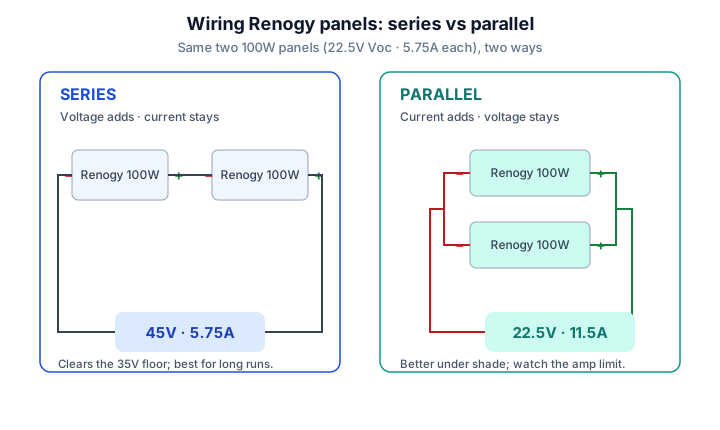
Series raises voltage, keeps current the same. Two 100W 12V panels in series = ~45V Voc, 5.75A Isc. Good for long cable runs (less voltage drop) and for hitting the AC200P’s 35V startup floor.
Parallel raises current, keeps voltage the same. Two 100W 12V panels in parallel = ~22.5V Voc, ~11.5A Isc. Good for partial shading scenarios — one shaded panel doesn’t drag the whole string down as hard as it would in series.
Series-parallel (sometimes written 2S2P, 3S2P) combines both. Two strings of two panels in series, wired in parallel with each other. This is how you build a 600-1000W array that stays inside both the voltage and current ceilings.
Step-by-Step: Wiring Renogy to Bluetti
Wire Renogy solar panels to a Bluetti power station
-
Read the back-of-panel label
Write down Voc, Vmp, Isc, and Imp for each panel. Renogy revs spec sheets; the label on the panel is what your unit will actually see.
-
Identify your Bluetti's input window
Confirm max Voc, max input current, and max watts from the cheat sheet above. For AC200P note the 35V lower limit.
-
Calculate series voltage with cold derating
Multiply panel Voc by the number of panels in series, then by 1.15. The result must be below your Bluetti's max input voltage. Example: three 100W panels (22.5V Voc) in series = 67.5V x 1.15 = 77.6V — well under AC200P's 150V ceiling.
-
Calculate parallel current
Multiply panel Isc by the number of parallel strings. Result must be below the unit's max input current. Two parallel strings of 200W Renogy panels = 10.45A x 2 = 20.9A — fits AC200MAX (15A)? No. So stay at one string of 200W panels in series, or step down to 100W panels for parallel.
-
Plug panels together
For a series string: panel 1 positive into panel 2 negative, panel 2 positive into panel 3 negative, and so on. The unused panel 1 negative and last panel positive become your string leads.
-
Add MC4 Y-branches for parallel strings
Each parallel string lead plugs into a Y-branch. Both positive leads merge into one positive output; both negative leads merge into one negative output. Two strings need one positive Y and one negative Y.
-
Test the open-circuit voltage
Before connecting to the Bluetti, point the array at sunlight and measure across the final leads with a multimeter. The reading should be close to your calculated Voc (within 5-10% — slightly lower than rated Voc unless very cold).
-
Connect to the Bluetti MC4 adapter cable
Match the MC4 connectors — positive to positive, negative to negative. The connector geometry prevents reversal.
-
Plug the adapter into the Bluetti solar input
AC200P, AC200MAX, and AC300 all use an aviation 7-pin solar input port; Bluetti ships an MC4-to-aviation adapter cable in the box. Listen for the click as the aviation connector seats.
-
Power the Bluetti on and watch input watts
On a clear day, expect 75-85% of rated panel wattage at the input display. A 400W array should read 300-340W around solar noon. Lower readings = shading, cable loss, or angle problem.
Real-World Array Builds Per Bluetti Model
Bluetti AC200P (35-150V, 12A, 700W max)
The AC200P needs at least 35V to start charging, so single 12V panels don’t work alone. Common builds:
- 2x Renogy 100W 12V in series: 45V Voc x 1.15 = 51.8V, 5.75A. Output: 200W. Easy starter setup.
- 3x Renogy 200W 12V in series: 72.9V x 1.15 = 83.8V, 10.45A. Output: 600W. Hits the AC200P’s sweet spot, well under 700W cap.
- 4x Renogy 175W 12V in series: 92V x 1.15 = 105.8V, 9.94A. Output: 700W. Maxes out the input but stays clean.
- 2x Renogy 320W 24V in series: 81.6V x 1.15 = 93.8V, 10.10A. Output: 640W. Fewer panels, less wiring, popular for RV roof installs.
Avoid 2-panel parallel builds with 200W Renogy panels — you’d hit ~21A, blowing past the 12A limit.
Bluetti AC200MAX (12-145V, 15A, 900W max)
The AC200MAX has the same 145V ceiling as the Elite 200 V2 but a slightly higher 15A current limit. Builds:
- 4x Renogy 200W 12V in series: 97.2V x 1.15 = 111.8V, 10.45A. Output: 800W.
- 3x Renogy 200W 12V in series + 1 parallel string of same: 72.9V x 1.15 = 83.8V, 20.9A. Exceeds 15A — don’t build this.
- 2x Renogy 320W 24V in series + 1 parallel string of 2x same (2S2P): 81.6V x 1.15 = 93.8V, 20.2A. Also exceeds 15A.
- 3x Renogy 320W 24V in series: 122.4V x 1.15 = 140.7V — pushes right up against the 145V ceiling. Skip unless you live somewhere warm year-round. With 1.20 derating it becomes 146.9V — over the line.
The AC200MAX rewards higher-voltage 24V panels in pure series. Parallel is rarely the right call.
Bluetti AC300 (12-150V, 12A per port x 2)
The AC300 has two independent MPPT ports, each capped at 12A and 150V, totaling 2400W solar input. You can build two separate strings — even mismatched ones — and feed each its own port. That’s the AC300’s biggest advantage.
- Per port: 4x Renogy 200W 12V in series = 97.2V x 1.15 = 111.8V, 10.45A. Output per port: 800W. Two ports: 1600W total.
- Per port: 3x Renogy 320W 24V in series = 122.4V x 1.15 = 140.7V, 10.10A. Output per port: 960W. Two ports: 1920W total.
- Per port: 5x Renogy 175W 12V in series = 115V x 1.15 = 132.3V, 9.94A. Output per port: 875W. Two ports: 1750W total.
If you want to push past 2000W, mix port assignments — one port handles a south-facing roof array, the other handles a ground-mounted east-facing string for morning capture. The AC300 tracks each port independently.
Common Mistakes That Cost You Watts
- Skipping the cold derating. An array that reads 142V Voc at 25C will read 158V at -15C. The Bluetti rejects it, the owner thinks the unit is broken.
- Mixing panel sizes in series. Series strings are limited by the lowest-current panel. A 100W panel in series with a 200W panel turns the string into a 100W-equivalent string.
- Mixing panel sizes in parallel. Parallel works better with mismatched panels, but voltages still need to be close (within ~10%) or the higher-Voc string back-feeds the lower one through the MPPT.
- Forgetting MC4 polarity at the Y-branch. Both positive leads must merge through a positive Y, both negative leads through a negative Y. Cross them and the array reads 0V or behaves erratically.
- Running thin cable. 14 AWG extension cables work for under 10A and 20 feet. Longer or higher-current runs need 12 AWG or 10 AWG, or you lose 5-15% to voltage drop. Renogy’s branded extensions are 10 AWG by default.
- Plugging into the wrong port. The AC200P has an aviation 7-pin solar input; the AC adapter charging port is separate and uses a barrel jack. Owners occasionally plug the MC4-to-aviation cable into the wrong port and assume the panels are dead.
If you’re getting an “input low” warning or 0W reading despite sunlight, the Bluetti troubleshooting steps in our Bluetti AC200P not charging from solar walkthrough cover the diagnostic order.
Cable Length and Voltage Drop
Voltage drop matters more than most builders realize. A 10A current over 30 feet of 14 AWG cable drops about 4% of voltage — call it 4V on a 100V string. That’s 40W lost on a 1000W array. Move to 10 AWG over the same run and you’re at 1.5%, or 15W lost.
Rough rules:
- Under 15 feet, under 10A: 14 AWG is fine.
- 15-30 feet, 10-15A: 12 AWG.
- 30-50 feet, 10-15A: 10 AWG.
- Over 50 feet: 8 AWG, or rewire as higher-voltage series to drop the current.
Series wiring naturally helps long runs because doubling voltage halves current for the same wattage, which quarters the voltage drop loss.
When Renogy Panels Don’t Fit Your Bluetti
A few edge cases where Renogy + Bluetti needs extra parts:
- EB70 with a 200W Renogy panel: The EB70 caps at 28V and 8A. A single 200W 12V Renogy panel (24.3V Voc, 10.45A Isc) exceeds the 8A limit. Use a 100W panel instead, or expect the EB70 to current-limit at ~190W.
- AC180 with a 200W panel: 58V max, 10A. A 200W 12V Renogy panel sits at 24.3V Voc, 10.45A Isc — borderline on current. Two 100W in series (45V, 5.75A) is cleaner.
- AC300 with 450W Renogy panels: 49.5V Voc each. Three in series = 148.5V x 1.15 = 170.8V — over the 150V ceiling. Use two in series per port (99V x 1.15 = 113.9V) instead.
For broader panel-to-station compatibility logic across brands, the solar panel compatibility guide covers the voltage/current matrix for every major portable power station.
Outdoor Wiring Notes
- Use UV-rated MC4 connectors and cable jackets. Indoor extension cords degrade in months under sun.
- Keep MC4 connections off bare ground. Moisture wicks in over weeks even with the rubber seal.
- Strain-relief panel leads at the frame so wind doesn’t tug the junction box.
- If you’re hardwiring through an RV wall, use a proper solar entry gland — not silicone over a drilled hole.
- Ground panel frames to vehicle chassis on mobile installs (Renogy panels have a ground lug on the frame).
Want to know exactly how long your panels will take?
Use our free Solar charge time calculator — it accounts for real panel output (not rated watts), charge-controller loss, and your local peak sun hours, so the number is honest. Get your result in 30 seconds.
FAQ
Frequently Asked Questions
Are Renogy solar panels compatible with all Bluetti models?
Can I mix Renogy 100W and 200W panels on the same Bluetti?
Why won't my Bluetti AC200P charge from a single Renogy 100W panel?
What's the largest Renogy array I can run on an AC300?
Do I need a charge controller between Renogy panels and a Bluetti?
How do I know if my MC4 connections are good?
Can I leave Renogy panels connected to my Bluetti overnight?
Bottom Line
Wiring Renogy panels to a Bluetti is mostly math and patience. Get the cold-weather Voc derating right, stay under the model’s amp limit, match panel sizes within each series string, and use thick enough cable for your run length. The MC4 connectors are designed to be foolproof and the Bluetti’s MPPT does the rest. Most arrays that “don’t work” turn out to be either below the AC200P’s 35V floor, above a model’s voltage ceiling once cold derating is applied, or wired through a reversed Y-branch. Walk through the calculation steps above before you crimp anything and you’ll skip every common failure mode.