
MC4 to XT60 Adapter Guide: Which Cable for Which Power Station (2026)
Complete MC4 to XT60 adapter reference. Which power stations take which connector, cable gauge sizing by run length, and pitfalls that fry input boards.
TL;DR: Most third-party solar panels terminate in MC4 connectors. Most portable power stations under 4000W (EcoFlow River/Delta 2, Bluetti EB70/AC180, Anker C800/C1000/F2000/F3800) accept XT60. Larger Bluetti units (AC200P/AC200MAX/AC300) use proprietary aviation plugs, and EcoFlow Delta Pro uses XT150/Anderson. Pick the adapter by checking your station’s input voltage range (typically 12-60V or 12-150V), not just the connector shape. Use 12AWG cable for runs under 25 feet, 10AWG for 25-50 feet, and 8AWG for runs over 50 feet to keep voltage drop under 3%.
This guide maps every common portable power station to the correct solar input connector, explains when you need an MC4 to XT60 adapter versus a different conversion, and covers the gauge sizing rules that prevent voltage drop from stealing your harvest.
For a complete troubleshooting guide covering all models, see our Common Bluetti Problems & Fixes (2026 Troubleshooting Guide).
Want to calculate this for your exact setup? Use our Solar charge time calculator — it accounts for real-world losses.
Want to calculate this for your exact setup? Use our What Size Power Station Do You Need? — it accounts for real-world losses.
Why MC4 to XT60 Is the Most Common Adapter
MC4 is the universal solar connector. Every rigid panel, most foldable panels from third-party brands (Renogy, Rich Solar, Newpowa, BougeRV), and almost every aftermarket cable uses the MC4 standard. It’s UL listed, IP67 rated, and locks with a positive click.
XT60 is the de facto input on small and mid-sized power stations because it handles up to 30A continuous, costs less to integrate than Anderson SB50, and is small enough to fit on the front panel of a 5kg unit. EcoFlow, Bluetti’s smaller line, Anker’s C-series, and most Chinese-OEM brands use XT60 (sometimes labeled “XT60i” with an extra signal pin for panel detection).
The mismatch between panel-side MC4 and station-side XT60 is why this single adapter is the most-sold solar accessory on Amazon. If you bought a non-brand-matched panel, you almost certainly need one.
Connector Reference Chart by Power Station
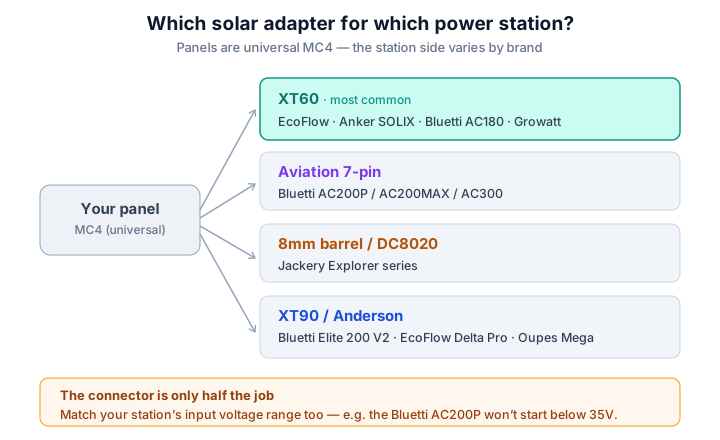
Match your unit to the correct input connector before buying any cable:
Bluetti Lineup
| Model | Solar Input | Voltage Range | Max Input |
|---|---|---|---|
| EB70 / EB70S | XT60i | 12-28V | 200W |
| AC180 | XT60 | 12-60V | 500W |
| AC200P | Aviation 7-pin | 35-150V | 700W |
| AC200MAX | Aviation 7-pin | 12-145V | 900W |
| AC300 | Aviation 7-pin (dual) | 12-150V | 2400W combined |
| Elite 200 V2 | XT90 | 12-60V | 1000W |
The Bluetti AC200P is the unit most people get wrong. Its 35V minimum input voltage means a single 100W 12V panel will not start charging — you need at least two panels in series, or a single high-voltage 24V/36V panel.
EcoFlow Lineup
| Model | Solar Input | Voltage Range | Max Input |
|---|---|---|---|
| River 2 / River 2 Max | XT60i | 11-30V | 110-220W |
| River 2 Pro | XT60i | 11-50V | 220W |
| Delta 2 | XT60i | 11-60V | 500W |
| Delta 2 Max | XT60i | 11-60V | 1000W |
| Delta Max | XT60 | 11-100V | 800W |
| Delta Pro | XT150 / Anderson | 11-150V | 1600W |
| Delta Pro 3 | XT150 | 12-150V | 2600W |
EcoFlow’s XT60i has a small signal pin that talks to the BMS. A standard MC4 to XT60 cable works fine, but EcoFlow’s own “smart” cables with the signal pin enable per-panel diagnostics in the app. Most users don’t need the signal version.
Anker SOLIX Lineup
| Model | Solar Input | Voltage Range | Max Input |
|---|---|---|---|
| C300 | XT60 | 11-32V | 100W |
| C800 / C800 Plus | XT60 | 11-32V | 300W |
| C1000 | XT60 | 11-60V | 600W |
| F2000 (767) | XT60 | 11-60V | 1000W |
| F3800 | XT60 (dual) | 11-60V | 2400W combined |
Anker’s lineup is the most consistent — every SOLIX from the C300 up through the F3800 uses XT60 (the F3800 has two XT60 inputs). Note the voltage ceiling: even the F3800 caps at 60V, so don’t string four 24V panels in series unless you want to trip the overvoltage protection.
Jackery Lineup
| Model | Solar Input | Voltage Range | Max Input |
|---|---|---|---|
| Explorer 300/500 | 8mm DC barrel | 12-30V | 100W |
| Explorer 1000 Plus | DC8020 | 12-50V | 800W |
| Explorer 2000 Plus | DC8020 | 12-60V | 1400W |
| Explorer 3000 Pro | Anderson | 12-60V | 1400W |
Jackery is the outlier — they use proprietary 8mm barrel connectors or DC8020 on most models, not XT60. You need an MC4 to 8mm or MC4 to DC8020 adapter, not the XT60 version. Buying the wrong adapter for a Jackery is the single most common mistake we see in reader emails.
Oupes, Allpowers, Growatt, Dabbsson
These brands almost universally use XT60 on units under 1500W and XT90 or Anderson on larger units. Check the input plate before ordering. Oupes Mega 1200 uses XT90 (people often guess XT60). Growatt Infinity 1500 uses XT60. Dabbsson DBS2300 uses XT90.
Cable Gauge Sizing — The Numbers That Actually Matter
Voltage drop is the silent killer of solar harvest. A cable that’s too thin can lose 10-15% of your panel’s output as heat before it ever reaches the station. Use these rules:
Run Length Rules
- Under 25 feet: 12AWG copper. Handles up to 30A with under 3% voltage drop at 24V.
- 25-50 feet: 10AWG copper. Required once you cross 25 feet at 20A+ to stay under 3% drop.
- 50-100 feet: 8AWG copper. Anything longer than 50 feet at any meaningful current needs 8AWG minimum.
- Over 100 feet: Reconfigure to series wiring (higher voltage, lower current) before upsizing further. 6AWG copper above 100 feet rarely makes economic sense — switching from 100W parallel at 18V to 100W series at 72V drops your current by 4x and lets you keep using 12AWG.
Why Voltage Drop Matters
At 18V (a single 100W 12V panel near MPP), 6A is your typical current. On 50 feet of 14AWG cable, you’ll lose around 1.1V — that’s 6% of your panel voltage, dropping output to 94W effective. On 12AWG over the same run, the drop is 0.7V (4%). On 10AWG, 0.4V (2%).
For a 400W array at 24V (16-17A), 12AWG over 30 feet drops about 1.5V — roughly 6% loss. Bump to 10AWG and you’re at 3.5%. The math always favors going one gauge heavier than you think you need.
Pure Copper, Not CCA
Cheap Amazon adapters often use copper-clad aluminum (CCA). The AWG number printed on the jacket might say 10AWG, but the actual current capacity is closer to 12AWG pure copper. Look for “OFC” (oxygen-free copper) or “pure copper” in the listing. If a 50-foot 10AWG MC4 cable costs $18, it’s CCA. Real OFC 10AWG costs $40-55 for 50 feet.
Common Compatibility Pitfalls
These are the failures we see most often in troubleshooting tickets:
1. Buying XT60 When You Need XT90
XT60 and XT90 look nearly identical — yellow plastic housing, banana-style bullets. The XT90 is about 50% larger and rated for 90A versus XT60’s 60A. If you force an XT60 plug into an XT90 socket, you’ll get an intermittent contact that arcs and pits the connector over a few weeks of use. Always measure the housing: XT60 is 16mm wide, XT90 is 20mm wide.
2. Exceeding Input Voltage on Series Strings
The Bluetti AC200P tops out at 150V open-circuit. Four 100W panels in series at 22.5V open-circuit each gives you 90V — fine. But four 200W panels at 24V open-circuit gives you 96V — still fine. Six of the same 24V panels in series gives you 144V — close to the limit on a cold morning when Voc spikes 10-15%.
Cold mornings push panel Voc up. A panel rated 22.5V Voc at 25°C can hit 26V at -10°C. If you sized your string for a 150V ceiling using STC numbers, you may exceed it on the first cold sunny morning and trigger overvoltage protection (or worse, blow the MPPT input stage).
Rule: Multiply your STC Voc by 1.15 before summing for series strings. Stay under 80% of the station’s stated maximum.
3. Mixing Panel Wattages or Brands in Series
Series strings sum voltages but current is limited by the weakest panel. Putting a 100W 6A panel in series with a 200W 9.5A panel caps the whole string at 6A. You lose roughly 30% of the larger panel’s output. Always match panel wattages in series strings.
In parallel, voltages must match instead. Putting a 12V panel (18V Vmp) in parallel with a 24V panel (36V Vmp) creates a current backfeed that can damage the lower-voltage panel and trip the bypass diodes.
4. Forgetting Reverse Polarity Protection
MC4 connectors are polarized — male and female are different shapes for a reason. XT60 connectors are also polarized but mistakes happen with branched adapters. If you build a parallel harness from MC4 Y-branches and the panels’ polarity is reversed on one leg, you’ll either get zero output (best case) or short-circuit the panels through each other (worst case).
Use an MC4 tester or a multimeter to confirm polarity before connecting anything to the station. A $25 MC4 tester pays for itself the first time it catches a wiring mistake before you blow a $40 panel. See our solar panel compatibility guide for the full safety checklist.
5. Ignoring the Station’s Minimum Voltage
The Bluetti AC200P needs 35V minimum to start charging. A single 100W 12V panel produces 18V Vmp — well below threshold. The station shows “0W solar input” and the user assumes a defective adapter. The fix is wiring two panels in series (36V combined) or buying a 24V/36V panel.
Always check your station’s minimum input voltage. EcoFlow Delta 2 starts at 11V (any panel works). Bluetti AC200P needs 35V. Anker C1000 needs 11V. The “minimum” spec matters as much as the maximum.
6. Using a Single Adapter for Parallel Connections
A standard MC4 to XT60 adapter has one MC4 male, one MC4 female, and one XT60. If you have two panels and want to wire them in parallel into a single XT60 input, you need an MC4 Y-branch first, then the MC4 to XT60 adapter. Buying two adapters and trying to splice them is unsafe and won’t fit the XT60 socket anyway.
Series vs Parallel: Quick Decision Guide
For 2-4 panels going into a station with a wide voltage range (Bluetti AC200P/AC200MAX, EcoFlow Delta Max/Pro), series wiring is almost always better:
- Higher voltage means lower current, less voltage drop, smaller cables.
- MPPT controllers track better at higher voltages.
- Shaded performance is worse in series (one shaded panel drops the whole string), but for unshaded setups series wins.
For stations capped at 30-60V (EcoFlow River 2, Anker C800, Bluetti EB70), parallel is your only option once you exceed two panels. Use 10AWG MC4 Y-branches and keep total current under the station’s input amp rating.
If your station’s input is rated 11-60V at 600W max (Anker C1000), four 200W panels in series at 80V open-circuit would exceed the ceiling. Two pairs of two in parallel (40V, 30A) is the right config — but verify your station’s amp limit too. C1000 caps at 10A per input despite the 600W spec, so you’d need to use both inputs.
Buying the Right Adapter — What to Look For
Spec sheet must say:
- Pure copper conductors (OFC), not CCA.
- Cable gauge clearly stated — 10AWG is the sweet spot for most setups.
- Connector rating: MC4 should be TUV or UL listed. XT60 should be branded (Amass is the OEM; clones work but Amass is more durable).
- Length matched to your run. Don’t buy a 30-foot adapter to connect a panel 5 feet from the station — extra coil = extra resistance and a mess.
- Polarity printed on both ends. Quality adapters mark + and - on the MC4 side.
Skip “smart” or “monitoring” cables unless your power station explicitly supports them (EcoFlow’s signal-pin XT60i is the main example). They add cost without benefit on dumb inputs.
When to Skip the Adapter Entirely
Brand-matched panels save you the adapter hassle. EcoFlow’s 220W bifacial panel ships with an XT60 cable that plugs directly into any Delta. Bluetti’s PV200 ships with MC4 plus a built-in MC4-to-aviation adapter for AC200P/AC300. Anker’s 200W panel ships with XT60.
If you’re buying a single panel for a single station, the brand-matched option often costs only $30-50 more than an off-brand panel plus adapter, and you skip every compatibility headache. The math flips when you’re buying 3+ panels — third-party panels with MC4 connectors are typically 30-40% cheaper per watt, and the savings dwarf the $15 adapter cost.
Final Picks by Use Case
- Single 100-200W panel, station under 1000W: Standard MC4 to XT60 adapter, 10 feet, 12AWG. Around $15-20.
- Two panels in series, station 1000-2000W: MC4 to XT60 cable, 10 feet, 10AWG. Around $25-35.
- 2-4 panels parallel or series, station 2000W+: MC4 Y-branch plus MC4 to XT90 or Anderson adapter, 10AWG, 25-foot runs. Around $50-80 total.
- Portable setup, 50+ foot runs to a remote panel: 8AWG MC4 extension to within 10 feet of the station, then a short 10AWG adapter. Around $80-120.
For Bluetti owners specifically, the AC200P guide on solar troubleshooting covers the voltage-threshold problem in depth — see Bluetti AC200P not charging from solar for diagnostic steps when the adapter is correct but harvest is still zero.