
Nebulizer Wattage: How Many Watts Does a Nebulizer Use?
Exact nebulizer wattage: compressor vs mesh, how many watts to power one during outage, and the right size power station.
The short answer: a nebulizer is one of the lightest medical loads you can put on a power station. A typical home compressor nebulizer uses only about 35 watt-hours per 15-minute treatment, so a 1,000Wh station delivers roughly 24 treatments — about a week at three treatments a day — if the nebulizer is the only thing running. A portable mesh nebulizer draws so little (≈1–2W) it barely registers at all. So the real question is almost never “how long” — it’s “how many treatments” and “can my station also run the fridge and CPAP at the same time?” This guide gives you the actual math.
Important — read first. This article covers the electrical engineering of running a nebulizer from a battery: watts, watt-hours, and treatments per charge. It is not medical advice and not a substitute for your equipment supplier’s or physician’s guidance. If your nebulized medication is time-sensitive (for example, during an asthma or COPD flare), do not rely on a single power source — keep a rescue inhaler or other prescribed backup on hand, and confirm any outage plan with your provider.
How many watts does a nebulizer use?
A standard home compressor (jet) nebulizer uses about 50–180 watts — most full-size units land around 140W. A portable mesh nebulizer uses far less, roughly 1–2 watts, which is why it runs on AA batteries or a USB power bank. Your exact figure is printed on the unit’s rating label. Because a single treatment only lasts 5–15 minutes, even a 140W compressor draws just about 35 watt-hours per session — so for backup-power sizing, the wattage matters less than how many treatments you need, which is what the rest of this guide works out.
A nebulizer is not an oxygen concentrator — don’t size it the same way
This is the most important point, and it’s the opposite of the mistake people make with oxygen concentrators. An oxygen concentrator runs continuously — often 24 hours a day — so you size for hours of nonstop draw. A nebulizer runs in short bursts: a single treatment is typically 5–15 minutes, taken a few times a day (per multiple medical-information sources; your prescription sets the actual frequency). Between treatments it draws nothing.
That changes the math completely. You don’t ask “how many hours will it run?” You ask “how many treatments fit in this battery?” — and because each treatment is so small, the answer is usually “far more than you’ll need before the grid comes back or you can recharge.”
The two types of nebulizer draw wildly different power
| Type | Typical use | Power draw | Startup surge | Power source |
|---|---|---|---|---|
| Compressor / jet | Standard home unit (DeVilbiss, Drive, Philips Respironics, etc.) | ~50–180W (most full-size units ≈140W) | Mild — small diaphragm-pump motor | AC wall outlet (some offer an optional 12V DC cord) |
| Mesh / portable | Travel, on-the-go (Omron MicroAir, PARI, etc.) | ≈1–2W | None | AA batteries or USB; battery runtime ≈4 hours of use per set |
Wattage figures are typical ranges from manufacturer spec sheets and aggregated owner reports — your unit’s exact draw is on its rating label or in its manual. For example, the DeVilbiss PulmoMate is listed at 140W; a compact Nidek unit at ~50W; the Omron MicroAir mesh nebulizer at roughly 1.2W on two AA batteries. Use your label number, not these ranges, for sizing.
The practical consequence: a mesh nebulizer barely needs a power station at all — a set of AA batteries or a small USB power bank covers many treatments. The power-station question really only matters for compressor nebulizers, and even then a compressor is a small load compared with a fridge, CPAP, or space heater.
The math: energy per treatment, treatments per charge
Energy per treatment (Wh) = Nebulizer watts × (treatment minutes ÷ 60)
Usable battery (Wh)        = Battery Wh × 0.95 × 0.85
Treatments per charge      = Usable battery ÷ Energy per treatment

  0.95 = LiFePO4 usable-capacity factor (you never get 100% out)
  0.85 = inverter conversion loss (AC output)
Worked example for a 140W compressor nebulizer, 15-minute treatment:
- Energy per treatment = 140 × (15 ÷ 60) = 35Wh
- A 1,000Wh LiFePO4 station ≈ 808Wh usable → 808 ÷ 35 = ~23 treatments
A 50W compact compressor at the same 15 minutes uses only ~12.5Wh — roughly 2.8× more treatments from the same battery. You can run your own numbers with the Runtime Calculator — enter your nebulizer’s label wattage and a 0.25-hour run time.
Treatments by power station size
Estimated treatments for a 140W compressor nebulizer at 15 minutes each (35Wh per treatment), using the derating above. The last column converts that to roughly how many days of therapy at three treatments per day — assuming the nebulizer is the only load.
| Power station | Usable Wh | Treatments @ 140W/15min | ≈ Days at 3/day |
|---|---|---|---|
| EcoFlow River 2 (256Wh) | ~207 | ~6 | ~2 days |
| Anker SOLIX C1000 (1,056Wh) | ~853 | ~24 | ~8 days |
| EcoFlow Delta 2 (1,024Wh) | ~827 | ~23 | ~8 days |
| Bluetti AC200P (2,000Wh) | ~1,615 | ~46 | ~15 days |
| Anker SOLIX F3800 (3,840Wh) | ~3,100 | ~88 | ~29 days |
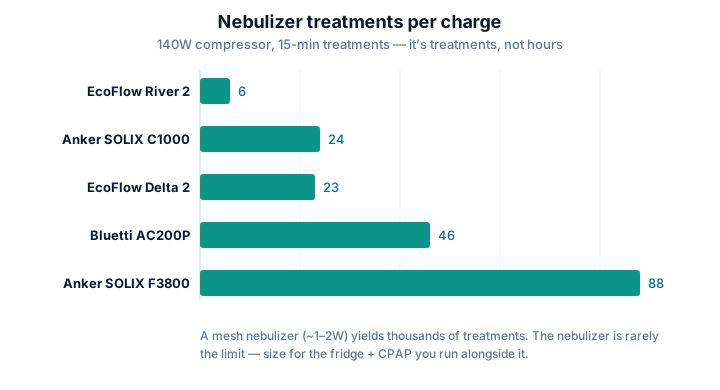
A mesh nebulizer (≈1–2W) would yield thousands of treatments from any of these — it’s effectively free to run. The numbers above are why we keep saying the nebulizer itself is rarely the constraint.
The real constraint: everything else you run during the outage
If the only thing you needed was nebulizer treatments, even a small 256Wh station covers a couple of days. In a real outage you’re usually running the nebulizer alongside other essentials — and those set the size you need:
- Fridge (~100–200W cycling, ~1–2kWh/day) — see refrigerator backup sizing
- CPAP overnight (~30–60W for 8 hours) — see best power station for CPAP
- Well pump (high surge, sometimes 240V) — see can a power station run a well pump
- Phones, lights, router (small but constant)
Add a fridge and a CPAP and your daily load jumps from ~0.1kWh (nebulizer alone) to ~2–3kWh. Size for the whole load, not the nebulizer. The nebulizer is a rounding error on top of it.
The startup surge (and pure sine wave) note
Compressor nebulizers use a small diaphragm-pump motor, so there is a brief startup surge — but it’s modest, nothing like a refrigerator compressor or a home oxygen concentrator’s inrush. Any pure sine wave station rated 300W or more starts a compressor nebulizer without drama; this is rarely a failure point.
Two things still worth checking:
- Pure sine wave. Like CPAP motors and fridge compressors, a nebulizer’s motor prefers a clean pure-sine AC waveform. Every station we recommend below is pure sine — avoid cheap “modified sine wave” inverters for any motor-driven medical device.
- Mesh nebulizers have no surge at all — they’re solid-state. If you only run a mesh unit, ignore surge entirely.
DC and battery options skip the inverter
- Mesh nebulizers run on AA batteries or USB. Charging from a power station’s USB port draws a watt or two and skips the inverter’s ~15% loss entirely — the most efficient possible setup.
- Some compressor nebulizers ship with (or offer) an optional 12V DC car adapter. If yours does, running it from the station’s car/DC port skips the inverter loss the same way it helps CPAP users. Use only the manufacturer’s official DC cord — wrong DC voltage can damage the unit.
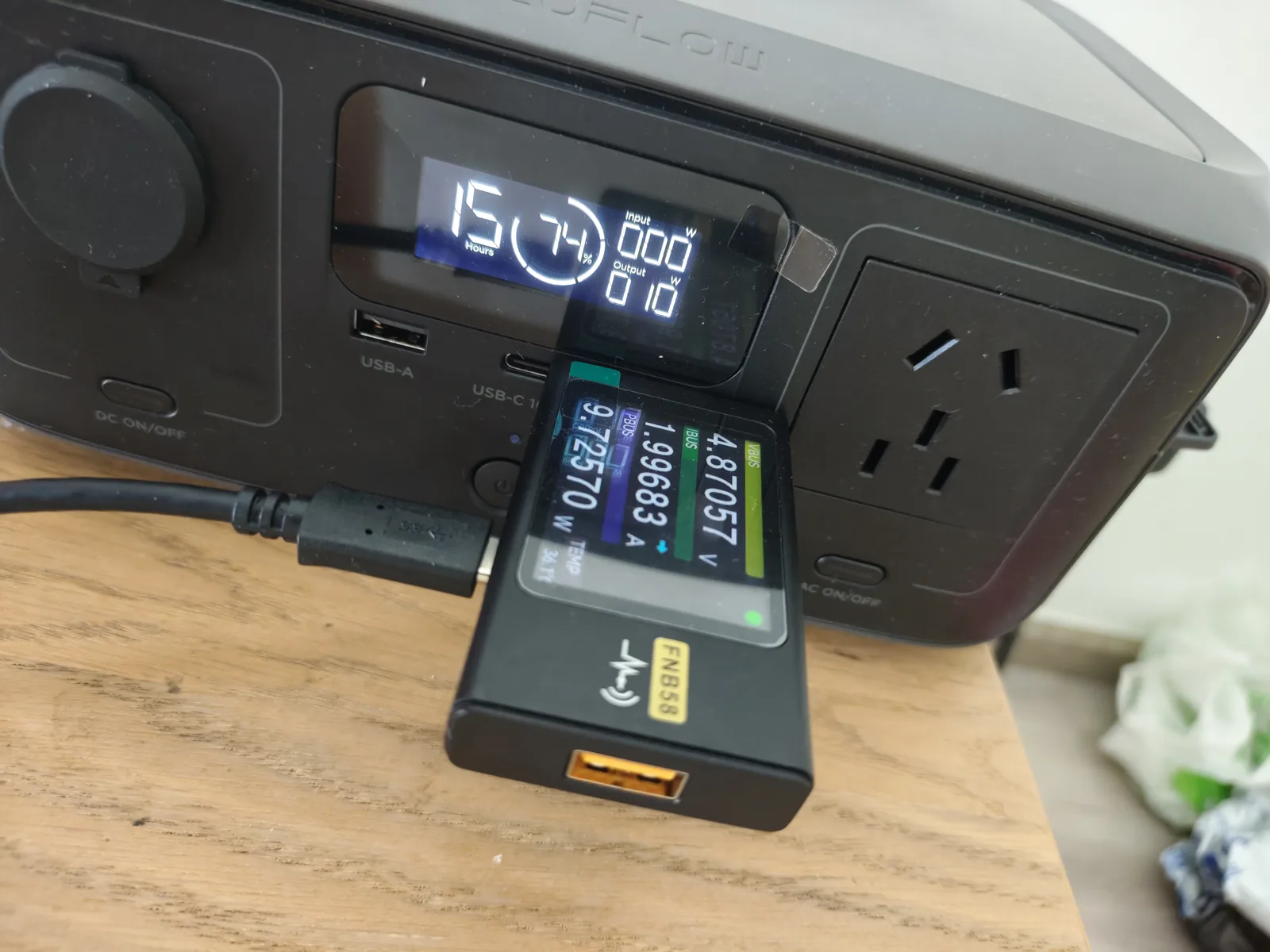
From our test bench. Low-watt output is exactly what small stations handle well. In our EcoFlow RIVER 3 lab tests (245.76Wh unit, full methodology in our RIVER 3 charging test), both USB-A ports held a steady ~9.7W load for 10 minutes with less than 0.1% power drift and no dropouts (metered at 4.87V / 9.73W), and a 6–7W router ran from the AC outlet for 4 continuous hours — about 26Wh delivered — without any auto-shutdown under our test settings. A nebulizer’s 5–15 minute burst sits comfortably inside that envelope; the constraint in a real outage is everything else you run, not the nebulizer.
Picks by scenario
Confirm your own nebulizer’s label wattage before buying. For most people the station is being bought for the whole outage load, with the nebulizer as one small piece.
Travel / mesh nebulizer only → EcoFlow River 2 (or just batteries)
If you use a portable mesh nebulizer, you barely need a power station for it — a set of AA batteries or a USB power bank covers many treatments. A small 256Wh unit like the River 2 is plenty if you also want to keep phones and a light going, and it’s the lightest thing to carry.
Compressor nebulizer + a few essentials → Anker SOLIX C1000 / EcoFlow Delta 2
A ~1,000Wh pure sine station runs a 140W compressor nebulizer for ~24 treatments and has the headroom to keep a fridge cycling for several hours or charge devices. Both the C1000 (1,056Wh, 1,800W) and Delta 2 (1,024Wh, 1,800W) are pure sine with easy surge headroom for a nebulizer’s small motor. The Delta 2 accepts an add-on battery if your needs grow.
Nebulizer + fridge + CPAP, full night → Bluetti AC200P
At 2,000Wh with a 4,800W surge rating (per Bluetti’s spec sheet), the AC200P comfortably carries a nebulizer plus a fridge and an overnight CPAP — the realistic medical-outage bundle — without breaking a sweat on startup loads.
Multi-day outage or whole-home medical backup → Anker SOLIX F3800 + solar
At 3,840Wh and expandable, the F3800 covers a nebulizer plus heavier continuous loads (including a home oxygen concentrator) across a multi-day outage, and pairs with solar to recharge between days. This is the configuration for anyone whose household runs more than one medical device — but it still belongs alongside your prescribed non-electric backups, not instead of them.
A note on the brands
The leading power station brands here — EcoFlow, Bluetti, Anker SOLIX — are all engineered in and around Shenzhen, and they publish detailed continuous-output and surge specifications (sometimes in more depth in their Chinese-language documentation than the English marketing pages). When sizing for any medical load, work from those published continuous and surge wattage figures, cross-checked against your nebulizer’s actual label — not the headline peak-watt number on the box.