
Can a Power Station Run a Well Pump? (And What Size You Need)
What really decides whether a power station can run your well pump: 240V vs 120V, the 3–5x startup surge, and why battery capacity is rarely the limit.
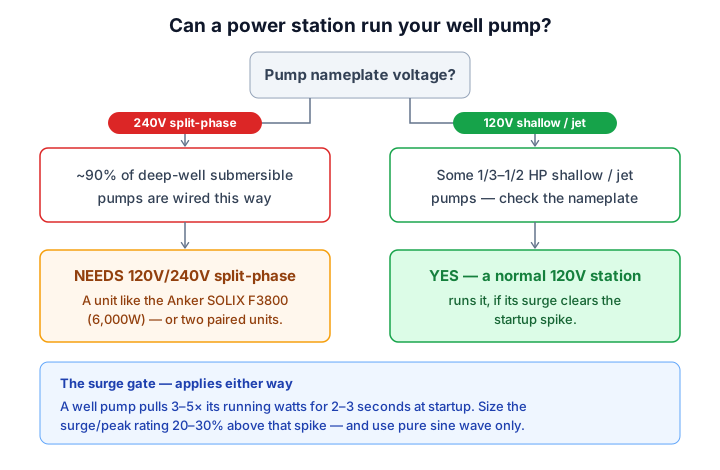
The short answer: yes — but two things decide it before battery capacity ever matters. First, voltage: over 90% of deep-well submersible pumps in North American homes run on 240V split-phase, and a 120V power station physically cannot run them. Second, startup surge: a well pump’s motor pulls 3–5x its running watts for the first 2–3 seconds. Get those two right and capacity is rarely the problem, because a well pump only runs a few minutes a day. This guide walks through all three in order.
Important — electrical safety. A hardwired 240V well pump must be connected through a proper manual transfer switch or generator inlet, installed by a licensed electrician — never by back-feeding an outlet or improvising wiring. This article covers the sizing math (volts, watts, surge). It does not replace a qualified electrician for the connection itself.
Want to calculate this for your exact setup? Use our What Size Power Station Do You Need? — it accounts for real-world losses.
Gate 1: Voltage — the #1 reason a power station “won’t run my well pump”
This catches more people than any wattage miscalculation. Over 90% of submersible deep-well pumps in North American homes are wired for 240V split-phase (per multiple generator-sizing and well-pump sources). A standard portable power station outputs 120V only — so no matter how big its battery is, it simply cannot drive a 240V pump.
Your three options:
- A station with native 120V/240V split-phase output. The Anker SOLIX F3800, for example, delivers 6,000W of 120V/240V split-phase — enough to start and run most residential well pumps directly.
- A 120V pump. Smaller shallow-well and jet pumps (often 1/3–1/2 HP) are sometimes 120V. Check your pump’s nameplate or pressure-switch wiring — if it’s 120V, a normal power station can run it (surge permitting).
- A step-up transformer (120V → 240V). Possible, but the transformer must be rated to handle the pump’s surge, not just its running watts, and it adds loss and complexity. For most people, options 1 or 2 are cleaner.
Check your pump’s nameplate voltage first. Everything below assumes you’ve cleared this gate.
Gate 2: Startup surge — size for the spike, not the running watts
A well pump motor has to overcome the inertia and the weight of the water column the instant it starts, so it draws a brief inrush of 3–5x its running wattage for the first 2–3 seconds (per multiple sources). Buy for running watts alone and you’ll watch the inverter trip every time the pump kicks on.
Typical figures (your pump’s nameplate is the source of truth):
| Pump size | Typical running watts | Startup surge | Typical voltage |
|---|---|---|---|
| 1/3 HP shallow / jet | ~500–750W | ~1,500–2,000W | often 120V |
| 1/2 HP submersible | ~750–1,000W | ~2,250W | usually 240V |
| 3/4 HP submersible | ~1,000–1,500W | ~3,000W | 240V |
| 1 HP submersible | ~1,500W | ~3,750–5,000W | 240V |
Figures are typical ranges from manufacturer and generator-sizing references; deep-well units can surge higher. A common rule of thumb is to size the station’s surge/peak rating 20–30% above the pump’s startup spike. Because a pump’s motor is an inductive load, it also wants a clean pure sine wave — avoid modified-sine inverters entirely.
Gate 3: Capacity is rarely the binding constraint
Here’s what surprises people: once a station can start the pump and match its voltage, the battery size usually isn’t the problem. A well pump doesn’t run continuously — it cycles on to refill the pressure tank (typically a minute or two at a time, triggered by water use), then shuts off. Cumulative daily runtime for a typical household is well under an hour, so daily energy is often under ~1kWh.
For those who want the math:
Energy per day (Wh) = Running watts × cumulative hours the pump runs per day
Usable battery (Wh) = Battery Wh × 0.95 × 0.85
A 1,000W pump running a cumulative 45 minutes a day uses ~750Wh. A 2,000Wh station (≈1,600Wh usable) holds roughly two days of that — and you’ll usually be recharging from solar or the grid before then. Actual mileage depends on your household’s water use, well depth, and tank size; run your own numbers with the Runtime Calculator.
The takeaway: prioritize voltage and surge rating over raw watt-hours. A huge battery that can’t start the pump is useless; a right-voltage, high-surge station with moderate capacity covers days of water.
A soft starter can shrink what you need
A soft starter (an add-on device wired at the pump) ramps the motor up gradually, cutting the startup surge dramatically. With one fitted, a smaller inverter or power station that couldn’t handle the raw inrush may run the pump comfortably. If your pump’s surge is the obstacle and you’d rather not jump to a 6,000W station, a soft starter installed by an electrician is often the cheaper fix. (It addresses surge, not the 240V voltage question — that gate still applies.)
Picks by scenario
Clear Gate 1 (voltage) first, then match Gate 2 (surge). Confirm your pump’s nameplate before buying.
120V shallow / jet pump (1/3–1/2 HP) → Bluetti AC180
If your pump is 120V and small, the AC180’s 1,800W continuous / 2,700W surge (per Bluetti’s spec) starts most 1/3 HP and efficient 1/2 HP 120V pumps, and it’s the most affordable, portable option here.
120V pump up to ~1 HP needing surge headroom → Bluetti AC200P
The AC200P’s 4,800W surge rating (per Bluetti’s spec sheet) swallows the inrush of larger 120V pumps that trip smaller inverters, while its 2,000Wh battery holds days of intermittent pump cycles.
240V split-phase submersible (the 90% case) → Anker SOLIX F3800
This is the unit for a typical hardwired 240V deep-well pump. The F3800 outputs 6,000W of 120V/240V split-phase, enough to start and run most residential submersible pumps, and at 3,840Wh (expandable) it covers multiple days of pump cycling — plus your fridge and other essentials. Connect it through a transfer switch installed by an electrician.
240V via paired units → EcoFlow Delta Pro
A single Delta Pro is 120V/3,600W. To get 240V split-phase you pair two Delta Pros with EcoFlow’s Double Voltage Hub or a Smart Home Panel — a valid route if you’re building an EcoFlow ecosystem, though it’s more hardware than a single split-phase unit like the F3800.
Extending runtime with solar
Because the pump’s daily energy is modest, even a few hundred watts of solar can offset a day’s pumping in good sun. Size the battery to clear the surge and voltage gates and to hold a day or two of water on its own, then treat solar as the recharge that makes a multi-day outage survivable. For continuous medical loads on the same system, see how long a power station runs an oxygen concentrator.
A note on the brands
The split-phase-capable stations here — Anker SOLIX, EcoFlow, Bluetti — are all engineered in and around Shenzhen, and they publish detailed continuous output, surge, and (critically) voltage/phase specifications, sometimes in more depth in their Chinese-language documentation than the English marketing pages. For a well pump, the spec that matters most isn’t the headline watt-hours — it’s the surge rating and whether the unit can produce 240V split-phase. Read those two numbers against your pump’s nameplate before anything else.