
How Long Will a Power Station Run an Oxygen Concentrator?
Real runtime math for powering an oxygen concentrator from a portable power station — typical wattages, the startup-surge gotcha, and capacity sizing by unit type.
The short answer: a 1,000Wh power station runs a portable (pulse-dose) oxygen concentrator for roughly 8–20 hours, but a home (continuous-flow) concentrator for only 2–3 hours. The gap is enormous because the two types of concentrator draw wildly different power — and the home units add a startup surge that trips undersized inverters. This guide gives you the actual math, by concentrator type, so you can size correctly.
Important — read first. This article covers the electrical engineering of running a concentrator from a battery: watts, watt-hours, and runtime. It is not medical advice and not a substitute for your equipment supplier’s guidance. Oxygen is life-sustaining for many users. Confirm any backup-power plan with your oxygen provider and physician, always keep a backup oxygen source (cylinder), and never rely on a single power station as your only contingency. The startup surge issue below can prevent a concentrator from turning on at all — which is exactly why redundancy matters.
First: which kind of concentrator do you have?
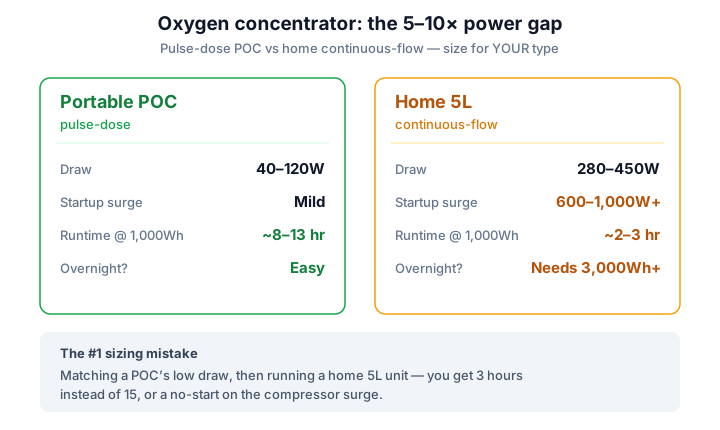
This is the entire ballgame. The two categories differ by 5–10x in power draw.
| Type | Typical use | Continuous wattage (AC) | Startup surge |
|---|---|---|---|
| Portable / pulse-dose (POC) | Travel, mobility (Inogen One, GCE Zen-O, Caire FreeStyle, etc.) | 40–120W | Mild (small or no compressor inrush) |
| Home / continuous-flow (stationary, 5L) | Bedside, 24/7 home therapy (Philips EverFlo, Respironics, DeVilbiss 5L, etc.) | 280–450W | High — compressor inrush can spike to 600–1,000W+ for a fraction of a second |
| High-flow home (10L) | Higher prescribed flow rates | 500–650W | Higher still |
Wattage figures above are typical ranges from manufacturer spec sheets and aggregated owner reports — your unit’s exact draw is on its rating label or in its manual. Use that number, not these ranges, for your own sizing.
The single most common mistake we see in forum threads (r/COPD, r/oxygen, DIY Solar Power Forum) is sizing for a portable concentrator’s low draw and then trying to run a home 5L unit — and either getting 3 hours instead of the expected 15, or having the inverter shut down on the compressor’s startup surge.
The runtime formula
Usable runtime (hours) = (Battery Wh × 0.95 × 0.85) / Concentrator continuous watts

  0.95 = LiFePO4 usable-capacity factor (you never get 100% out)
  0.85 = inverter conversion loss (AC output)
Worked examples for a 1,000Wh LiFePO4 station (≈808Wh usable after both factors):
- Pulse-dose POC at 60W: 808 / 60 = ~13 hours
- Pulse-dose POC at 100W: 808 / 100 = ~8 hours
- Home 5L at 350W: 808 / 350 = ~2.3 hours
- Home 5L at 450W: 808 / 450 = ~1.8 hours
You can run any combination yourself with the Runtime Calculator on this site — enter your concentrator’s label wattage and the station’s Wh.
Runtime by power station size
Estimated runtime at two representative draws — a 60W pulse-dose POC and a 350W home 5L unit. All figures use the formula above (0.95 × 0.85 derating), rounded.
| Power station | Usable Wh | POC @ 60W | Home 5L @ 350W |
|---|---|---|---|
| ~500Wh class | ~400 | ~6.5 hr | ~1.1 hr |
| Anker SOLIX C1000 (1,056Wh) | ~853 | ~14 hr | ~2.4 hr |
| EcoFlow Delta 2 (1,024Wh) | ~827 | ~13.5 hr | ~2.3 hr |
| Bluetti AC200P (2,000Wh) | ~1,615 | ~27 hr | ~4.6 hr |
| Bluetti AC200MAX (2,048Wh, expandable) | ~1,654 | ~27.5 hr | ~4.7 hr |
| Anker SOLIX F3800 (3,840Wh) | ~3,100 | ~51 hr | ~8.8 hr |
The takeaway: for a portable concentrator, a 1,000Wh unit covers an overnight easily. For a home 5L concentrator, even a 2,000Wh unit only buys you a half-night — to cover a full night or a multi-hour outage you want 3,000Wh+ or an expandable system, plus solar (see below).
The startup-surge gotcha (why some stations fail to start a home unit)
Home continuous-flow concentrators use a compressor, and compressors draw a brief inrush current at startup that can momentarily spike to 600–1,000W or more even on a unit that runs at 350W continuous. Two failure modes owners report:
- Inverter trips on startup — an 1,000W-rated inverter may refuse to start a unit whose surge exceeds its peak rating, even though it could easily handle the 350W continuous load afterward.
- It starts on wall power but not on battery — if your concentrator was already running when you plugged it into the station (pass-through), it’s fine; but a cold start from the battery alone is the harder case.
This is why surge headroom matters more than continuous rating for home concentrators. Stations with high peak-surge ratings (e.g., the Bluetti AC200P’s 4,800W surge, per Bluetti’s spec sheet) start compressor loads without drama. Always check the station’s surge/peak watts, not just its continuous watts, against your concentrator’s startup draw.
Picks by scenario
These are sized to the runtime and surge realities above. Confirm your own concentrator’s label wattage and surge before buying.
Portable concentrator, overnight or travel → Anker SOLIX C1000 / EcoFlow Delta 2
A ~1,000Wh LiFePO4 station gives a 60W pulse-dose POC roughly 13–14 hours — a full night with margin. Both the C1000 (1,056Wh, 1,800W) and Delta 2 (1,024Wh, 1,800W) are pure sine wave with enough surge headroom for a POC’s mild startup. The Delta 2 accepts an add-on battery if you later need more.
Home 5L concentrator, several hours of outage → Bluetti AC200P / AC200MAX
For a 350W home unit, a 2,000Wh station delivers ~4.5 hours, and the AC200P’s 4,800W surge rating handles compressor startup cleanly. The AC200MAX adds expandability — bolt on a B230/B300 battery and you scale toward whole-night coverage.
Home 5L, full night or multi-day outage → Anker SOLIX F3800 + solar
At 3,840Wh, the F3800 runs a 350W home concentrator roughly 8–9 hours on battery alone — close to a full night. Pair it with solar input and you can sustain a daytime load and recharge between nights. For anyone whose oxygen is continuous and prescribed, this expandable-plus-solar approach is the only configuration that approaches true grid-independence — but it still belongs alongside, not instead of, a backup cylinder.
AC vs DC: skip the inverter if your concentrator allows it
Many portable concentrators accept DC input (a 12V/24V car-style cord from the manufacturer). If yours does, powering it from the station’s DC output (car port or USB-C PD) skips the inverter’s ~15% loss and gives you noticeably longer runtime than via the AC outlet — the same trick that benefits CPAP users.
Use only the concentrator manufacturer’s official DC cord — wrong DC voltage damages the unit. Home 5L concentrators are generally AC-only, so this option mostly applies to portable units.
Extending runtime with solar
A power station plus solar input can sustain a concentrator through daylight and bank surplus for the night:
- Portable POC (60W): even 100–200W of solar more than covers the draw in good sun, effectively indefinite daytime runtime.
- Home 5L (350W): you need 400–600W+ of solar to both run the unit and bank charge — realistic on a sunny day, marginal under heavy overcast. Size the battery to cover the night on its own and treat solar as the recharge.
See LiFePO4 vs lithium-ion for why LiFePO4 chemistry (3,000+ cycles) is the right choice for any unit you’ll cycle daily for medical backup.
A note on the brands
The leading power station brands here — EcoFlow, Bluetti, Anker SOLIX — are all engineered in and around Shenzhen, and they publish detailed continuous-output and surge specifications (sometimes in more depth in their Chinese-language documentation than the English marketing pages). When sizing for a medical load, work from those published continuous and surge wattage figures, cross-checked against your concentrator’s actual label — not from the headline “2000W” on the box, which is a peak-marketing number.