
How Long Will a Power Station Run a Chest Freezer? (Real Runtime Math)
Compressor surge sizing plus the cycling effect that stretches real runtime 2-3x beyond the naive estimate — with a quick Wh-to-hours worksheet for outage prep.
The short answer: easily — and longer than most people expect. A chest freezer only draws 100–350W while its compressor runs, and because the compressor cycles on and off (running just 30–50% of the time), a 1,000Wh power station realistically keeps a small chest freezer cold for the better part of a day, and a 2,000Wh unit can carry a large one well past 24 hours. The two things that trip people up are the startup surge (the compressor briefly pulls far more than its running watts) and the duty-cycle math — handle those and a freezer is one of the easiest appliances to back up.
First, a money-saving move before you plug anything in. A full freezer stays frozen on its own for roughly 48 hours with the door shut (about 24 hours if it’s half full), per USDA guidance. So in a short outage you may not need to power it at all — just keep the lid closed. This article covers the electrical engineering of running one from a battery; for food safety, follow USDA rules (refreeze only if food still has ice crystals or is at/below 40°F; discard anything above 40°F for 2+ hours). This is general information, not food-safety advice for your specific situation.
What a chest freezer actually pulls
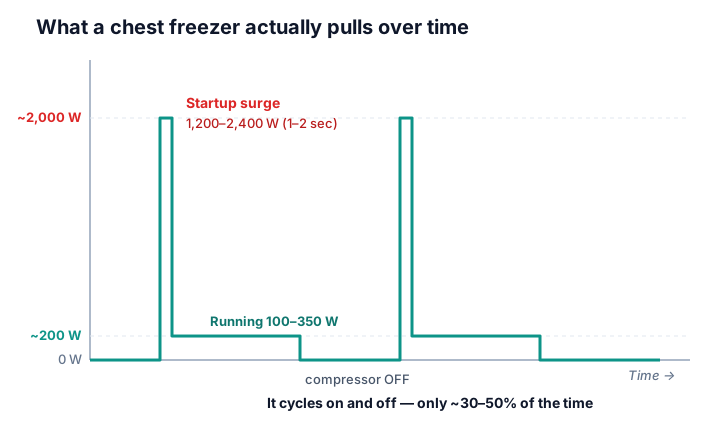
Two numbers matter, and they’re very different: the running watts (steady draw while the compressor is on) and the surge watts (the 1–2 second spike when it starts).
| Freezer | Running watts | Startup surge | Typical use |
|---|---|---|---|
| Small chest (5–10 cu ft) | 100–200W | ~600–1,200W | Garage backup, apartments |
| Large chest (15–25 cu ft) | 250–350W | ~1,200–2,400W | Bulk/deep storage, preppers |
| Upright freezer | 150–350W | ~1,000–2,400W | Kitchen/garage, auto-defrost draws more |
Figures are typical ranges from appliance energy documentation and manufacturer labels. Chest freezers are usually more efficient than uprights (better insulation, cold air doesn’t spill out when opened), so a chest unit will run longer on the same battery than an upright of the same size.
The surge gotcha (size for this, not the running watts)
When the compressor kicks on it draws a brief inrush of roughly 3–6× its running watts — a 250W freezer can spike to 1,200–2,400W for a second or two. A power station that has plenty of continuous watts can still fail here if its surge/peak rating is too low: it’ll trip and shut off the moment the compressor tries to start.
So the first spec to check is the unit’s surge watts, the same way you’d size for a well pump or any other motor load. Every station below has surge headroom well above a freezer’s startup spike.
The runtime formula
Continuous runtime (hours) = (Battery Wh × 0.95 × 0.85) / Running watts

  0.95 = LiFePO4 usable-capacity factor
  0.85 = inverter conversion loss (AC output)
That gives the continuous figure — battery life if the compressor never shut off. Worked examples for a 1,000Wh LiFePO4 station (≈808Wh usable):
- Small chest at 120W: 808 / 120 = ~6.7 hours continuous
- Large chest at 250W: 808 / 250 = ~3.2 hours continuous
But a freezer compressor doesn’t run continuously — see the duty-cycle section below, which is what turns those hours into a full day or more. Run your own numbers with the Runtime Calculator.
Runtime by power station size
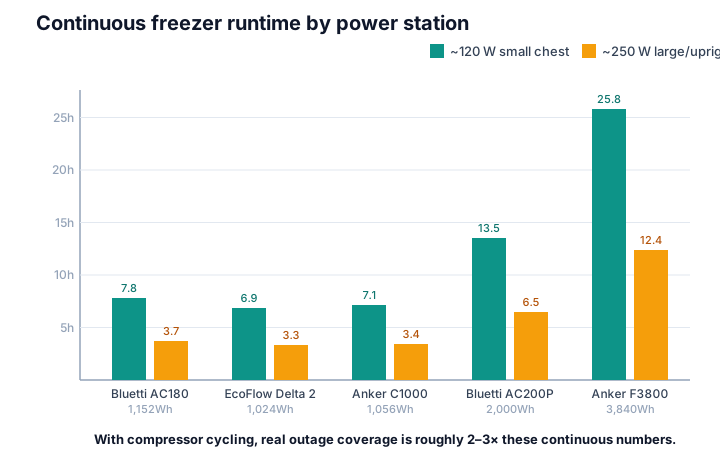
Estimated continuous runtime, using the derating above, for a small (~120W) and large (~250W) freezer.
| Power station | Usable Wh | Small chest @120W | Large @250W |
|---|---|---|---|
| Bluetti AC180 (1,152Wh) | ~930 | ~7.8 hr | ~3.7 hr |
| EcoFlow Delta 2 (1,024Wh) | ~827 | ~6.9 hr | ~3.3 hr |
| Anker SOLIX C1000 (1,056Wh) | ~853 | ~7.1 hr | ~3.4 hr |
| Bluetti AC200P (2,000Wh) | ~1,615 | ~13.5 hr | ~6.5 hr |
| Anker SOLIX F3800 (3,840Wh) | ~3,100 | ~25.8 hr | ~12.4 hr |
Backing up more than the freezer? Our measured runtime data across 7 critical devices puts CPAP, fridge, furnace, pellet stove and oxygen concentrator in one master comparison table, so you can size a single station for the whole outage rather than one appliance at a time. And if someone in the house depends on a nebulizer during outages, we’ve sized that separately too — see nebulizer wattage and runtime for the surge profile and per-charge session math.
Duty cycle: why the real numbers are 2–3× better
This is the part the textbook formula misses. A freezer’s compressor cycles — it runs to pull the box back down to temperature, then shuts off until it drifts up again. Across a day a freezer’s compressor typically runs only 30–50% of the time (a well-stocked chest freezer in a cool room sits at the low end; an upright in a hot garage at the high end).
That means real-world runtime is roughly the continuous figure divided by the duty cycle — about 2–3× longer:
- A 1,000Wh station on a small chest (~6.7 hr continuous) realistically covers 15–20 hours.
- A 2,000Wh station on a large chest (~6.5 hr continuous) realistically covers 16–20+ hours.
Two cheap tricks push it further: keep the lid shut (every opening dumps cold air and forces a long compressor run), and fill empty space with frozen water jugs so the thermal mass holds cold and the compressor cycles less often.
For a multi-day outage: add solar
Because a freezer’s average draw is so low (a 250W freezer at 40% duty averages only ~100W, or ~2.4kWh a day), even a modest 200–400W solar array can roughly offset a day’s consumption in decent sun — turning a big battery into an indefinite freezer backup. This is the realistic setup for riding out a multi-day storm outage.
The pure-sine-wave requirement
A freezer’s compressor motor needs a clean pure sine wave. A cheap modified-sine inverter can make the motor run hot, hum, or fail to start, and shortens its life. Every power station recommended here is pure sine wave — never run a freezer (or any compressor) from a modified-sine unit.
Picks by scenario
Check your freezer’s running watts (on the rating label or in the manual) and confirm the station’s surge rating clears the startup spike.
Small chest freezer, ride out a typical outage → Bluetti AC180 / EcoFlow Delta 2 / Anker SOLIX C1000
A small chest freezer pulls only ~100–200W running, so a ~1,000Wh pure sine station carries it most of a day with cycling — and still has headroom for phones and a couple of lights. The AC180 (1,800W / 2,700W surge) is the affordable pick; the Delta 2 and C1000 add capacity and surge margin.
Large/deep freezer, full day+ → Bluetti AC200P
A large chest or upright at 250–350W running, with a startup surge up to ~2,400W, wants more battery and surge headroom. The AC200P’s 2,000Wh battery and 4,800W surge rating (per Bluetti’s spec sheet) swallow the compressor inrush and give you a comfortable day-plus with cycling.
Freezer + fridge + lights, multi-day → Anker SOLIX F3800 + solar
At 3,840Wh and expandable, the F3800 runs a freezer alongside a fridge and lights, and pairs with solar to recharge between sunny spells — the configuration for a multi-day outage. See our refrigerator backup picks if the fridge is your main concern.
A note on the brands
The pure-sine stations here — Bluetti, EcoFlow, Anker SOLIX — are engineered in and around Shenzhen and publish detailed continuous and surge output specs (sometimes in more depth in their Chinese-language documentation than the English pages). For a freezer, the number that decides whether it’ll even start is the surge/peak watts versus your compressor’s 1,200–2,400W inrush — read that spec, not just the headline continuous rating, before you buy.