
EcoFlow RIVER 3 vs RIVER 3 Plus: How to Verify the Model
RIVER 3 and RIVER 3 Plus look easy to confuse. Here is how to verify the box, nameplate, app model, and what to do if the delivered unit does not match the listing.
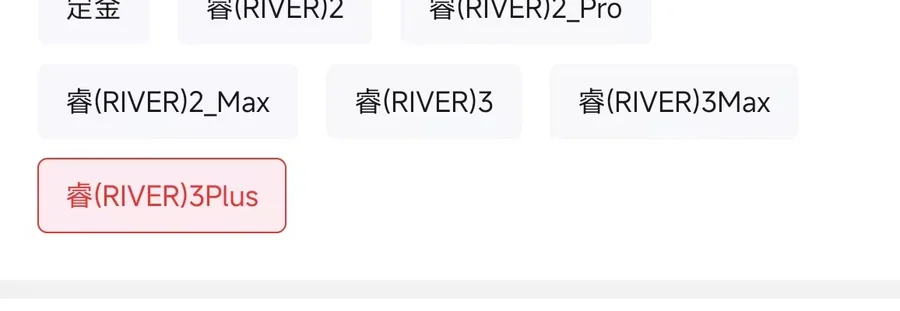
Short version: the EcoFlow RIVER 3 and RIVER 3 Plus are not the same product. The current US RIVER 3 is the smaller 245Wh / 300W model. The RIVER 3 Plus is the larger 286Wh / 600W model with extra-battery expansion support. Because seller pages can mix names, bundles, thumbnails, and regional SKUs, verify the physical unit before you accept the results of any review, return window, or warranty claim.
This guide exists because our own test unit made the problem real. We selected a listing option labeled RIVER 3 Plus, but the box label, bottom nameplate, quick-start guide, app, battery capacity, and performance envelope all identified the delivered power station as a regular RIVER 3, model EFR705. We published the hands-on data as an EcoFlow RIVER 3 review, not as a RIVER 3 Plus review.
RIVER 3 vs RIVER 3 Plus: the differences that matter
For US shoppers, the practical difference is power class. The regular RIVER 3 is a compact electronics station; the RIVER 3 Plus is the step-up model for people who need more AC output, faster UPS transfer on the official spec sheet, and battery expansion.
| Current US specification | RIVER 3 | RIVER 3 Plus |
|---|---|---|
| Battery capacity | 245Wh | 286Wh |
| Rated AC output | 300W | 600W |
| USB-C output | 100W max | 100W max |
| UPS transfer claim | Under 20ms | Under 10ms |
| Extra battery expansion | No | Yes |
| Best fit | Laptops, routers, cameras, small electronics | Heavier electronics, more AC headroom, expandable setup |
Those are not tiny naming differences. If you expected the Plus and received the regular RIVER 3, a 300W AC ceiling is not a defect in that unit; it is the normal limit of the smaller model. If you expected the smaller RIVER 3 and received a Plus bundle, the extra battery bay and larger inverter can change size, price, and use case.
What happened in our order
Our seller page and option selector used Plus wording. The product gallery showed a stacked battery system, and the selected variant said RIVER3Plus. That created a reasonable buyer expectation that the order was for the Plus configuration.
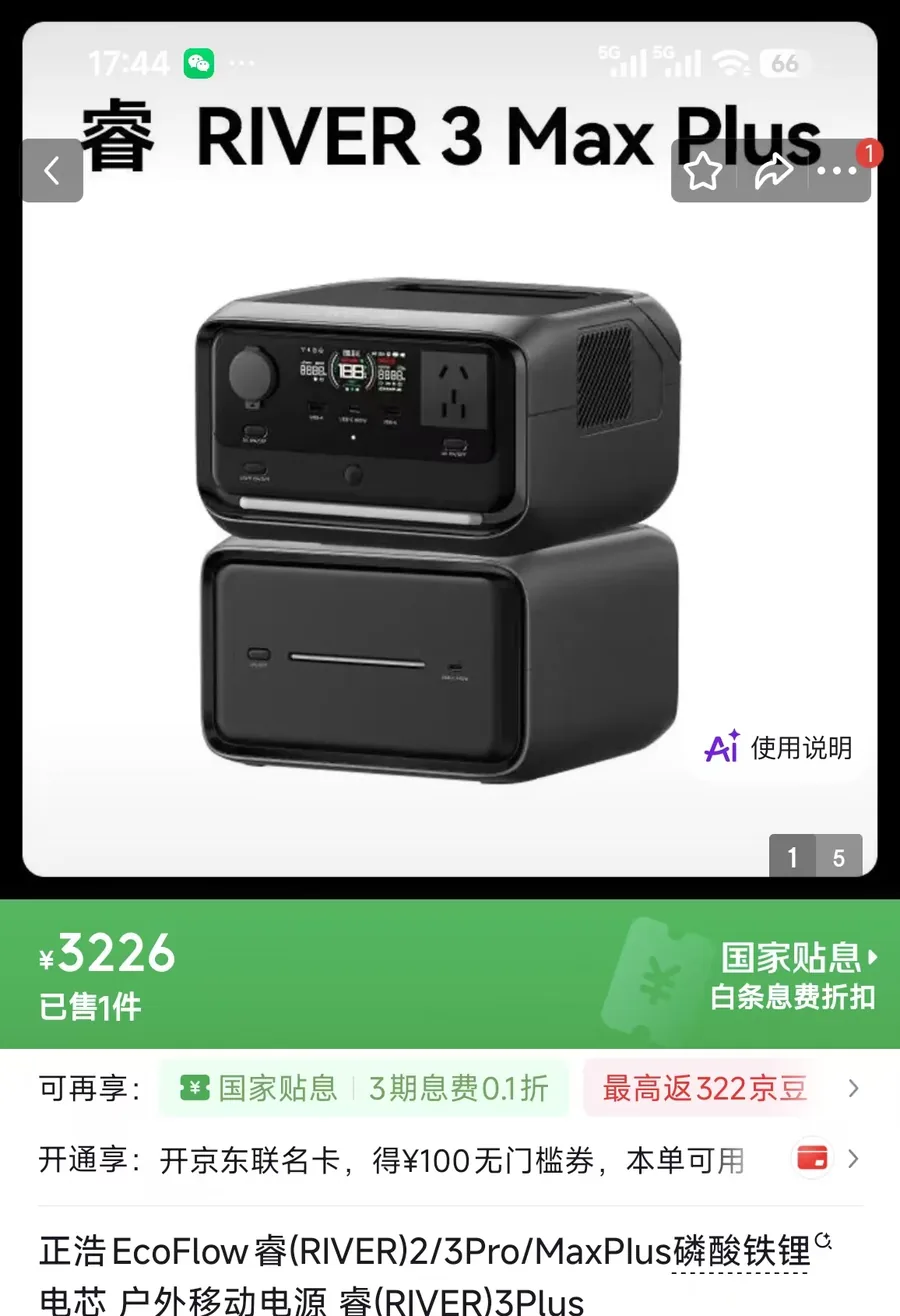
The listing and selected option used Plus wording. We cropped this public image to avoid showing unrelated shopping account details.
The variant selector also showed RIVER3Plus. The public crop excludes address, account, and order details.
The delivered unit did not match that naming. Its shipping label identified it as RIVER 3, model EFR705, with 10ms UPS wording for this China-market 220V regional unit. The bottom nameplate matched a 245.76Wh, 300W AC, 100W USB-C RIVER 3 class unit. The printed quick-start guide and EcoFlow app also identified it as RIVER 3.
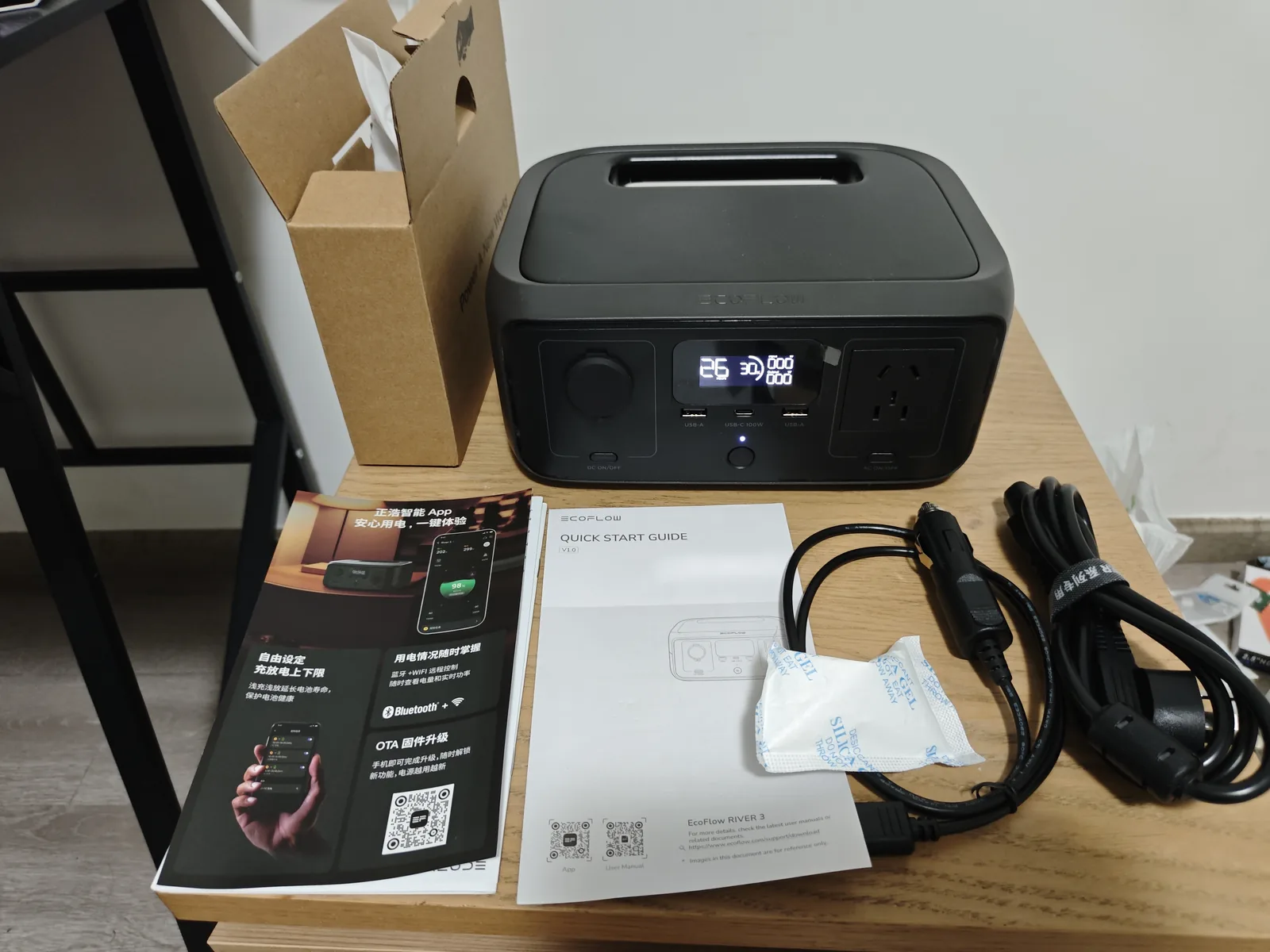
What came out of the box: the compact RIVER 3 body, its cables, and the printed quick-start guide — all of which identified the unit as RIVER 3, not RIVER 3 Plus.
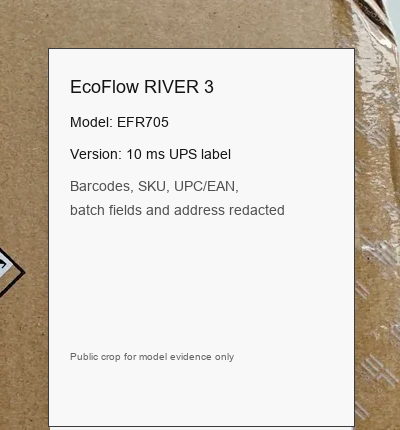
The public image preserves only the model evidence. Barcodes, SKU/UPC/EAN, batch fields, and address details are redacted.
That is why our review is careful with wording: we tested a real RIVER 3, not a RIVER 3 Plus.
How to verify which model you received
Do not rely on only one place. The box, the product body, and the app should agree.
- Check the shipping label first. Look for the product name and model code on the outer box. Photograph it before opening if the order looks suspicious.
- Check the bottom nameplate. Capacity and AC output are the fastest clues. A 245Wh / 300W unit is the regular RIVER 3 class; a 286Wh / 600W unit is the Plus class.
- Check the manual or quick-start guide. The printed insert usually follows the actual packed product more closely than a marketplace title.
- Bind the device in the EcoFlow app. The app model name is useful evidence, especially if you need to contact the seller.
- Compare the ports and expansion support. If the unit has no extra-battery expansion capability, it should not be treated as a RIVER 3 Plus.
If any of these disagree, stop testing and document the mismatch while the return or exchange window is still open.
Here is what the nameplate check looks like in practice — this is the bottom label of our delivered unit:
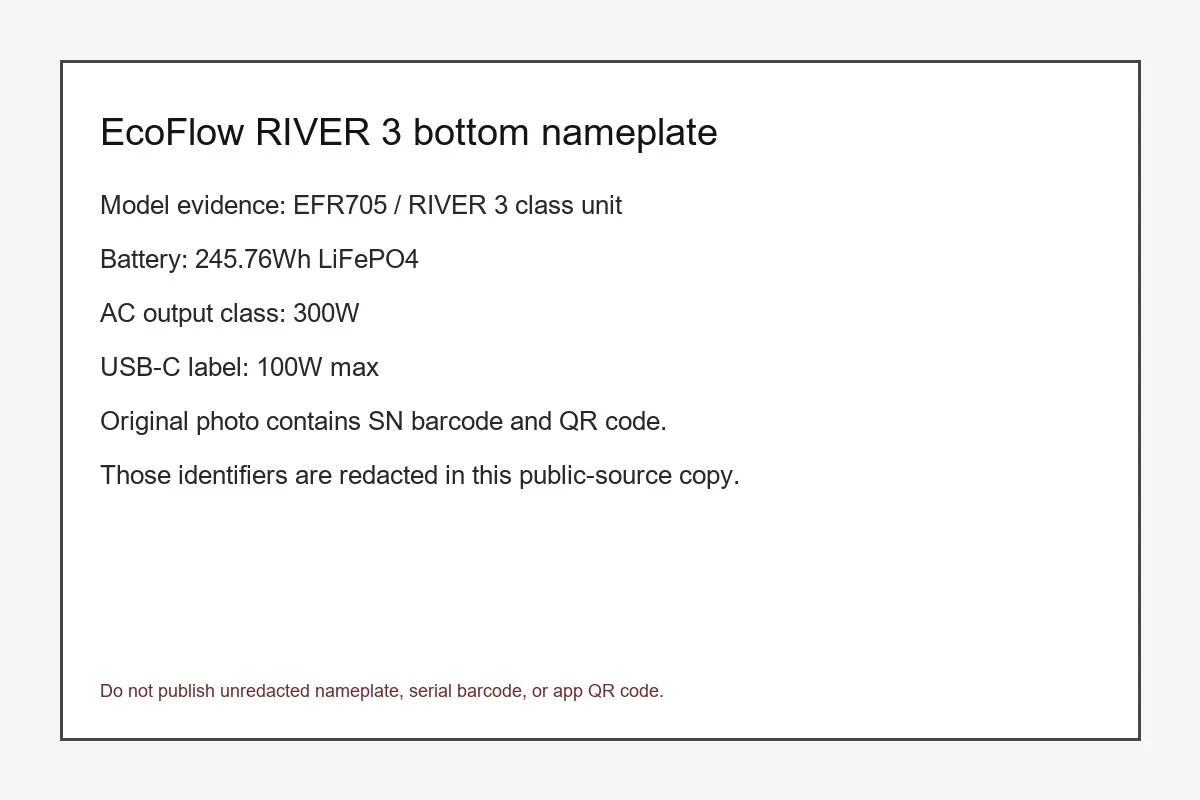
The fastest model check: a nameplate reading 245.76Wh / 300W AC means the regular RIVER 3 class (model EFR705). A RIVER 3 Plus nameplate would show 286Wh and 600W AC.
Why this matters for reviews and buying decisions
The difference changes the conclusion. A regular RIVER 3 can be excellent for a laptop, router, camera kit, mini PC, or small monitor. In our hands-on test, it delivered an estimated 216.8Wh over USB-C at a 100W-class load, recharged from 3% to 100% in 51 minutes (full session data in our EcoFlow RIVER 3 charging test), and kept a mini PC plus monitor alive through three observed cutovers.
But those results do not prove how the RIVER 3 Plus performs. The Plus has a different inverter class, different battery capacity, and expansion support. If a site publishes RIVER 3 data as a RIVER 3 Plus review, the capacity, runtime, AC limit, and buying advice become misleading.
The reverse is also true. A RIVER 3 Plus review cannot be used to promise that the smaller RIVER 3 will run the same AC loads.
What to do if your order does not match
Keep the process boring and well documented. Boring evidence wins disputes.
- Take screenshots of the listing title, selected option, cart, and order summary.
- Photograph the unopened box label if possible.
- Photograph the bottom nameplate after opening.
- Screenshot the EcoFlow app model page after binding.
- Do not remove or damage labels until the seller responds.
- Contact the seller with a neutral message: “The order option shows RIVER 3 Plus, but the delivered box and nameplate show RIVER 3. Please confirm whether this is the correct SKU or arrange an exchange.”
- If the seller says the listing option was only a bundle name or regional naming variant, ask them to point to the exact capacity, AC output, and expansion-battery spec for the delivered unit.
Avoid starting with accusations. The useful question is simple: does the physical unit match the SKU and performance class you paid for?
Regional SKUs can make this more confusing
Our unit was a China-market 220V device. The current US RIVER 3 page and RIVER 3 Plus page are 120V retail products, and their published UPS transfer claims differ from the label on our regional unit. That is normal in this category: AC voltage, plug type, certification, and sometimes printed transfer-time claims can vary by market.
So the right comparison is always exact SKU to exact SKU. If you are buying in the United States, use EcoFlow’s US product pages for the official retail spec. If you are buying in China, Europe, Australia, or another market, use the regional page and the local nameplate.
Our recommendation
If you want the lightest compact station for USB-C devices and small AC electronics, the regular RIVER 3 can make sense. It is the model we actually tested, and our full RIVER 3 review explains its capacity, charging, heat, noise, USB-A, USB-C, low-power AC, and UPS behavior. We also published a dedicated USB-C 100W deep-dive with stepped-load stability data and cable lessons.
If you need more AC headroom, expansion battery support, or the official under-10ms US UPS claim, compare the RIVER 3 Plus directly and make sure the delivered box says Plus before you start relying on it.
The practical rule is blunt: choose by the nameplate, not the listing thumbnail.
Source notes
For the current US retail specifications, check EcoFlow’s official RIVER 3 product page, RIVER 3 Plus product page, and RIVER 3 series comparison page. Our delivered-unit evidence comes from the photos, app screenshots, and test logs collected during our July 2026 RIVER 3 review project.