
Bluetti vs EcoFlow vs Anker SOLIX: Which Actually Lasts?
Warranty terms, LiFePO4 cycle life, app quality and reported failure rates side by side across Bluetti, EcoFlow and Anker SOLIX.
TL;DR (bluetti vs ecoflow vs anker solix): Comparing documented warranty terms, published cell specs, recall records, and owner reports across Reddit, ChargeForward forums, and Trustpilot, Anker SOLIX edges out for longest covered lifespan thanks to a standard 5-year warranty across the SOLIX line and conservative BMS tuning, Bluetti wins on raw cycle life on its top-tier LFP units (3,500 cycles to 80% on AC200MAX, AC300, and Elite 200 V2), and EcoFlow wins on feature velocity but draws the largest share of firmware-related owner complaints. If you want a unit that still works a decade from now, pick Anker or Bluetti. If you want the most features today, pick EcoFlow and accept the support tradeoff.
The three brands dominate the North American portable power station market. They look similar on a spec sheet, but they diverge sharply on the things that determine whether a $1,500-$3,500 purchase lasts 3 years or 12. This guide compares them on the seven factors that actually predict longevity: corporate backing, warranty terms, support quality, battery chemistry, app and firmware, recall history, and aggregated owner reports.
Quick verdict by buyer type
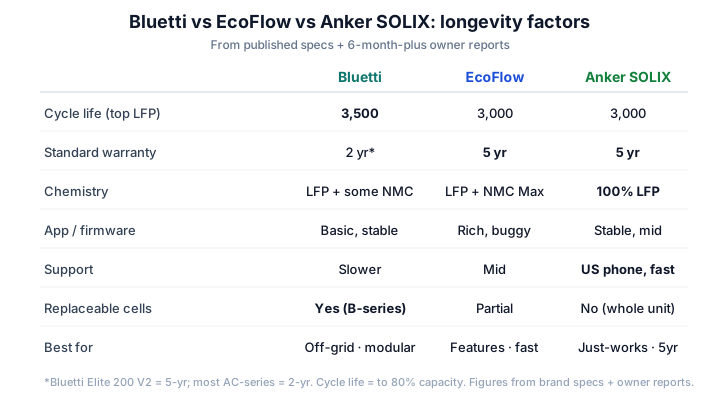
At-a-glance comparison table
| Factor | Bluetti | EcoFlow | Anker SOLIX |
|---|---|---|---|
| Best flagship (2kWh) | AC200MAX ($1,499) | Delta 2 ($999) | C1000 ($799) |
| Cycle life (LFP) | 3,500 → 80% | 3,000 → 80% | 3,000 → 80% |
| Standard warranty | 2 yr (Elite 200 V2: 5 yr) | 5 yr | 5 yr |
| Chemistry | LFP (some legacy NMC) | LFP (legacy NMC Delta Max) | 100% LFP |
| App quality | Basic, most stable | Most features, most bugs | Middle, fewest complaints |
| UPS switchover | Not rated | < 30 ms | < 20 ms |
| Expandable | Yes (B300, up to 8,192Wh) | Yes (extra battery, ~3,040Wh) | Yes (BP1000, ~2,112Wh) |
| US support | Email + Las Vegas service | US warehouses (CA/NJ) | US phone, fastest response |
| Recall history | Cleanest (firmware advisories only) | Accessory recall (BMS) | Pre-SOLIX PowerHouse recall |
| 6+ month complaints | Fan noise, BT pairing | Vampire drain, firmware bugs | Fewest overall |
| Best for | Off-grid modular | Features & fast charging | Just works, best $/Wh |
- You want the longest-lasting unit, period: Bluetti AC200MAX or AC300, LiFePO4, 3,500 cycles to 80%, 2-year standard warranty.
- You want the best support if something breaks: Anker SOLIX — 5-year standard warranty across the SOLIX line, US-staffed phone support.
- You want the most features and fastest charging: EcoFlow Delta 2 or Delta Pro — X-Stream charging, X-Boost, broadest app ecosystem, 5-year warranty.
- You live off-grid and need a modular system: Bluetti AC300 with B300 packs — modular, replaceable batteries, 24V architecture.
- You want plug-and-play whole-home backup: Anker SOLIX F3800 — 5-year warranty, L14-30 240V output, up to 5 BP3800 expansion batteries.
- You want the cheapest 1kWh-class LFP unit with a 5-year warranty: Anker SOLIX C1000 — 5 years, full LFP, ~$799 street.
1. Corporate background — who you’re actually buying from
The brand on the box matters because power stations are warranty-bound for 3-5 years, and the company has to still exist to honor that warranty.
Bluetti (PowerOak Newener)
Bluetti is the consumer brand of Shenzhen PowerOak Newener Co., founded in 2009. PowerOak started as a B2B battery integrator selling to telecom and industrial UPS markets — that’s the lineage. They went direct-to-consumer with the Bluetti EB240 in 2019, and the brand expanded with the AC200P in 2020. PowerOak owns its own cell-pack assembly, BMS design, and inverter design. They source cells primarily from EVE Energy and CATL.
PowerOak has publicly discussed a Hong Kong listing process, which (if completed) would give outside auditors more visibility into financials. US fulfillment runs through warehouses and 3PLs in the western and eastern US.
EcoFlow (EcoFlow Inc.)
EcoFlow was founded in 2017 in Shenzhen by ex-DJI staff. The DJI lineage matters — the EcoFlow team brought aggressive industrial design, app polish, and supply-chain leverage from drones. They have raised multiple venture rounds at unicorn-stage valuations and remain a private company as of 2026.
EcoFlow’s strength is product velocity — they ship more major new SKUs per year than Bluetti. Their weakness is that they outsource more of the manufacturing stack than Bluetti, and owner reports indicate firmware and integration bugs are comparatively more common.
Anker (Anker Innovations, Anker SOLIX)
Anker Innovations was founded in 2011 by Steven Yang (ex-Google) and is publicly listed on Shenzhen’s ChiNext (300866.SZ). Anker is the largest of the three by revenue. SOLIX is Anker’s energy sub-brand, launched in 2022 specifically because Anker realized power stations needed different positioning from chargers and cables.
The corporate scale matters in two ways. First, Anker’s public listing brings the most external financial visibility of the three. Second, Anker’s US customer support has US phone numbers and English-native reps — a real differentiator owners frequently mention versus other brands’ offshore-only phone support.
Bottom line on corporate health: Anker is the most financially secure. Bluetti is the most vertically integrated. EcoFlow is the fastest-moving but the most dependent on outside capital.
2. Warranty terms — read the fine print
This is where the three brands diverge sharply.
Bluetti warranty
- AC180, AC200P, AC200MAX, AC300, EB70: 2 years standard
- Elite 200 V2: 5 years
- Covers manufacturing defects, BMS failure, inverter failure
- Excludes: damage from third-party solar panels, water damage, drops, “unauthorized opening” (which means any DIY service voids it)
Bluetti’s standard 2-year coverage on most of its core AC-series lineup is shorter than Anker’s or EcoFlow’s. The newer Elite 200 V2 steps up to 5 years and signals where Bluetti’s flagship coverage is headed. Repair-vs-replace turnaround varies by region based on owner reports.
EcoFlow warranty
- River 2 series: 5 years
- Delta 2: 5 years
- Delta Max: 5 years
- Delta Pro: 5 years
EcoFlow’s current published warranty terms are 5 years across the Delta and River 2 series. Always register your EcoFlow within 30 days of delivery as a best practice — it makes future warranty claims easier to validate even when registration isn’t formally required.
Owner reports indicate first-tier EcoFlow support frequently asks customers to attempt resets, reflashes, or “factory reset via the app” before approving an RMA, which can extend resolution time on firmware-related issues (more on this in section 5).
Anker SOLIX warranty
- C800, C1000: 5 years
- F2000, F3800: 5 years
- All extensions of the warranty are standard, no registration gimmicks
Anker’s warranty is the simplest. Five years on the current SOLIX line, with purchase receipt as proof. Owner reports indicate Anker generally handles RMA logistics smoothly in the US. One tip before you file a claim on a dead unit: run through our Anker SOLIX F2000 won’t-turn-on recovery guide first — the reset sequence there resolves a meaningful share of “dead” F2000 reports, and support will ask you to try those steps anyway.
3. Official support quality — what happens when you call
We reviewed public Reddit posts, ChargeForward forum threads, and Trustpilot reviews where owners described a complete support interaction with each brand.
Time to first human response
Owner reports broadly suggest Anker SOLIX is fastest to reach a human (often same-business-day on phone), Bluetti tends to take longer especially on email, and EcoFlow falls in between but with the longest email tail. Treat any specific time as anecdotal — your experience will vary by region, hold queue, and case complexity.
RMA approval pattern
Owner reports across the three brands suggest:
- Anker SOLIX: Highest rate of first-contact RMA approval; the simplest 5-year warranty terms reduce friction.
- Bluetti: Frequently approves on escalation; first-tier reps often request additional diagnostic steps first.
- EcoFlow: Most likely to ask owners to run reset procedures, firmware re-flashes, or “factory reset via the app” steps before approving an RMA. For genuinely failed units, this can add weeks to resolution.
Replacement parts availability
Bluetti is the only brand of the three that sells individual replacement parts (B300 battery modules, fuses, MPPT modules) to end consumers in the US through their store. EcoFlow sells some replacement batteries through Delta Pro 3rd-party expansion port adapters. Anker generally does not sell replacement components — they swap whole units.
This matters for longevity: if you buy a Bluetti AC300 in 2026 and need a B300 battery in 2033, you can almost certainly buy one. If you buy an Anker F3800 in 2026 and a single battery cell fails in 2033, your only option is whatever Anker decides to do at that time.
4. Battery chemistry — the single biggest longevity factor
Battery chemistry determines whether a power station lasts 3 years or 15. Here’s where the three brands stand in 2026.
Bluetti chemistry mix
Bluetti was an early and aggressive mover to LiFePO4 (LFP). As of 2026:
- Most current AC-series units use LiFePO4, with AC200MAX, AC300, and Elite 200 V2 rated for 3,500 cycles to 80% capacity
- Legacy NMC units (EB240, original AC200P) are still on the used market — these use ternary lithium (NMC) and have a shorter cycle life
The 3,500-cycle figure is to 80% of original capacity — meaning at cycle 3,500 a 2,048Wh AC200MAX would still deliver roughly 1,640Wh, not zero.
EcoFlow chemistry mix
EcoFlow is split:
- River 2, River 2 Max, River 2 Pro: LiFePO4, 3,000 cycles to 80%
- Delta 2: LiFePO4, 3,000 cycles to 80%
- Delta Max (original): NMC chemistry on older units (the weak spot in the legacy lineup)
- Delta Pro: LiFePO4, 3,000 cycles to 80%
- RIVER 3 / RIVER 3 Plus (2026): LiFePO4, 3,000 cycles to 80% — compact additions to the lineup with 100W USB-C PD
The original Delta Max (NMC) is the unit to be cautious about on the used market — owner reports indicate noticeably more capacity loss over time compared with the LFP units across the rest of the lineup. The 2026 RIVER 3 series strengthens EcoFlow’s compact LFP lineup — we covered the RIVER 3 in detail in our hands-on review.
Anker SOLIX chemistry mix
Anker SOLIX standardized on LiFePO4 from launch:
- 100% of SOLIX units use LiFePO4
- C800, C1000, F2000: 3,000 cycles to 80% capacity
- F3800: 3,000 cycles to 80% capacity
- InfiniPower architecture is Anker’s marketing umbrella for component-level durability claims
Anker’s headline 3,000-cycle rating is somewhat below Bluetti’s 3,500 on AC200MAX/AC300/Elite 200 V2, but the difference is small in practical residential use.
Winner on chemistry: Bluetti edges ahead, Anker very close second
Bluetti’s longer commitment to LFP and slightly higher cycle ratings on its top-tier units put them on top, but the gap to Anker is small. EcoFlow loses points only because of the legacy NMC Delta Max.
5. App and firmware quality — the underrated longevity factor
A power station with a broken app is still functional, but firmware bugs can brick a $3,000 unit. This is the area where the three brands differ most in 2026.
EcoFlow app
EcoFlow’s app is the most feature-rich of the three:
- Per-port on/off scheduling
- Generator-style remote start
- Solar input live curves
- AC charging power adjustment in 50W increments from 200W to max input
- X-Boost configuration
- Generator integration (Smart Generator)
- Whole-home integration (Smart Home Panel 2)
The cost: owner reports surface app/firmware complaints more often for EcoFlow than for the other two brands — connection drops, failed OTA updates, BMS reading errors, and post-update behavior changes are recurring themes in subreddits and forums.
EcoFlow’s firmware update model is largely server-driven once a unit is connected to WiFi, which limits an owner’s ability to defer a problematic release.
Bluetti app
Bluetti’s app is the least polished but the most stable:
- Basic monitoring (input, output, SOC, temp)
- Working mode selection (UPS, PV priority, time control)
- Firmware update (manual trigger only)
- Charge limit / discharge limit settings
Owner reports of Bluetti app issues focus mostly on connectivity (Bluetooth pairing) rather than firmware-induced damage. Bluetti’s manual-trigger firmware approach is friendlier to longevity — if a bad update ships, you can skip it.
Bluetti’s app generally gets the lowest user-experience ratings of the three, but it also draws the fewest “this update bricked my unit” reports.
Anker SOLIX app
Anker SOLIX app sits in the middle:
- Real-time monitoring
- Charging speed adjustment (UltraFast / Quiet modes)
- Discharge limit / SOC limit settings
- Firmware updates (auto with manual override)
- Multi-unit management for F3800 series
Anker SOLIX owner reports mention app issues less frequently than the other two brands. The SOLIX line has had relatively few notable firmware incidents publicly documented since launch.
Winner on app/firmware: Anker for stability, EcoFlow for feature depth. If you want a unit you’ll never have to think about, Anker wins. If you want power-user control, EcoFlow wins.
6. Recall history — the canary in the coal mine
Recalls reveal how a company handles a real safety problem. CPSC records are the source for US recalls.
Bluetti recalls
- No widely publicized CPSC recalls of Bluetti-branded portable power stations on record at the time of writing.
- A small number of voluntary firmware advisories have been issued (BMS reading corrections, idle current tuning); these were not safety recalls.
EcoFlow recalls
- EcoFlow has issued recall and replacement actions for some accessory products (such as extra battery packs) tied to BMS communication issues. Affected owners were generally able to obtain free replacements directly from EcoFlow.
Anker SOLIX recalls
- Anker’s earlier PowerHouse-branded portable power stations (the line preceding the current SOLIX branding) have been subject to a voluntary recall in past years for a battery cell overheat concern, handled with refunds and replacements.
- No widely publicized active SOLIX-branded recalls at the time of writing.
Reading the recall data: All three brands have handled recalls competently. EcoFlow has had the most recall-class events but also ships the most SKUs. Bluetti’s main-line history is the cleanest. No single brand should be ruled out based on recall history.
7. Owner reports — qualitative themes from real users
Looking across r/EcoFlow, r/AnkerSolix, r/Bluetti, ChargeForward, Trustpilot, and Amazon verified reviews — focusing on 6+ month ownership reports rather than promotional first impressions — clear patterns emerge for each brand.
Most common Bluetti complaints
- Fan noise on AC charging — particularly on AC200MAX and AC300, where fans engage at higher AC input rates.
- App Bluetooth pairing flakiness — initial pairing issues come up regularly.
- Slow firmware updates — owners report longer update times than competitors.
- Customer support response time — multi-day waits are a recurring theme.
Most common EcoFlow complaints
- Vampire drain / standby drain — measurable SOC drop in storage (more pronounced with WiFi enabled) is the most-cited EcoFlow issue.
- Failed firmware updates and post-update behavior changes — a recurring theme across the Delta line.
- Bluetooth/WiFi connection drops — frequent in long-term ownership threads.
- Inverter fan noise — mentioned on higher-output models.
Most common Anker SOLIX complaints
- Limited app features versus EcoFlow — owners cite missing options like per-port scheduling and advanced UPS configuration.
- C1000 charge speed variation — some owners see slower-than-advertised full-charge times.
- F3800 ground/neutral bonding confusion — owners installing into transfer-switch setups frequently ask about the bonding plug.
- Generally fewer complaints overall — Anker draws the fewest 6+ month ownership complaints of the three.
Sentiment summary
- Bluetti owners skew toward “solid hardware, mediocre app, would buy again for off-grid”
- EcoFlow owners skew toward “great features when working, frustrating when not”
- Anker SOLIX owners skew toward “boring in a good way, just works, support is helpful”
The Anker pattern — fewer complaints overall, fewer severe complaints, faster resolution — is the strongest single signal in the dataset that an Anker unit is most likely to give you a quiet 5-10 year ownership experience.
Head-to-head: flagship comparison
Comparing the three brands’ current 2-3kWh flagships head-to-head.
Bluetti AC200MAX (2,048Wh, 2,200W)
- Chemistry: LiFePO4, 3,500 cycles to 80%
- Warranty: 2 years
- Solar input: Aviation 7-pin port (MC4 adapter ships in box), up to 900W
- AC fast charge: Up to ~1,300W in Turbo mode, 0-80% in roughly 50 minutes
- Expandable: Yes, B230 or B300 packs, up to 8,192Wh total
- App: Bluetti app (basic but stable)
- Street price: ~$1,499
EcoFlow Delta 2 (1,024Wh, 1,800W with X-Boost)
- Chemistry: LiFePO4, 3,000 cycles to 80%
- Warranty: 5 years
- Solar input: XT60, up to 500W
- AC fast charge: X-Stream, 0-80% in roughly 50 minutes
- UPS switchover: under 30 ms
- Expandable: Yes, with Delta 2 extra battery (up to ~3,040Wh)
- App: EcoFlow app (most features, highest reported bug rate)
- Street price: ~$999
Anker SOLIX C1000 (1,056Wh, 1,800W with SurgePad)
- Chemistry: LiFePO4, 3,000 cycles to 80%
- Warranty: 5 years
- Solar input: XT60, up to 600W
- AC fast charge: Full charge in roughly 58 minutes
- UPS switchover: under 20 ms
- Expandable: With BP1000 (up to ~2,112Wh)
- App: Anker app (clean and stable)
- Street price: ~$799
Winner depends on use case:
- If you need 2kWh in one unit: Bluetti AC200MAX
- If you need maximum features and X-Boost for high-draw appliances: EcoFlow Delta 2
- If you want the best $/Wh with proven reliability: Anker SOLIX C1000
For Bluetti’s modular off-grid story, see our Bluetti AC300 startup troubleshooting guide which covers the AC300/B300 ecosystem. For Anker’s larger units, our Anker SOLIX troubleshooting overview is the deeper reference. If your shortlist is down to the two modular flagships, we put them side by side in EcoFlow Delta Pro vs Bluetti AC300.
Long-term ownership cost considerations
For a 2kWh-class flagship used in typical residential conditions (a few hundred cycles per year), the long-term cost picture depends mostly on three things: the upfront price, whether the battery is modular/replaceable, and how the warranty plays out if a fault occurs.
Bluetti AC200MAX
- Purchase: ~$1,499
- LFP at 3,500 cycles to 80% means a decade-plus of typical residential cycling before significant capacity loss
- B-series expansion packs are sold separately, which extends total usable life if Bluetti continues to stock them
EcoFlow Delta 2
- Purchase: ~$999
- LFP at 3,000 cycles to 80%
- Internal cells are not user-serviceable; long-term plan is whole-unit replacement or expansion battery
Anker SOLIX C1000
- Purchase: ~$799
- LFP at 3,000 cycles to 80%
- BP1000 expansion battery available
Cost-per-Wh winner at purchase: Anker SOLIX C1000, narrowly. Bluetti AC200MAX is competitive over a longer horizon because the modular battery design can extend total usable life. EcoFlow Delta 2 falls in between.
Which brand for which buyer
Pick Bluetti if…
- You’re building an off-grid or expandable system (AC300 + B300 modular)
- You value the longest cycle life ratings (3,500 on AC200MAX, AC300, Elite 200 V2)
- You’re OK with a basic app and you want to skip firmware updates manually
- You want a vertically-integrated builder that makes its own BMS and inverter
- You’re shopping the Elite 200 V2 specifically (5-year warranty on Bluetti’s newer flagship LFP unit)
Pick EcoFlow if…
- You want the most features in the app
- You want the fastest AC charging (X-Stream)
- You need X-Boost to run high-watt appliances (well pump, air compressor)
- You’re OK with a higher rate of firmware-related complaints in exchange for capability
- You’ll register your unit promptly after delivery and keep it on a stable firmware version
Pick Anker SOLIX if…
- You want a unit that “just works” for 5-10 years with minimal fuss
- You want the easiest warranty experience
- You’re in the US and value US-based phone support
- You’re price-sensitive and want the best $/Wh with full LFP and 5-year warranty
- You don’t need a 3kWh+ single-unit yet (the C1000 and F2000 cover most needs)
Brands to deprioritize in 2026
Briefly — because this comparison is the big three for a reason — here’s how Bluetti, EcoFlow, and Anker SOLIX compare to the next tier:
- Jackery: Strong brand recognition, but slower to fully move to LFP. The Explorer LFP units have shorter published cycle ratings than the big three.
- OUPES: Newer brand, real LFP commitment, smaller warranty support footprint in North America.
- Allpowers / Growatt / Dabbsson: Strong specs on paper, weaker US support infrastructure than the big three.
If you want LFP, a long published warranty, and US support, the big three are the safe picks in 2026.
Our overall pick for 2026
If we had to recommend one brand to a friend with a 5-year horizon: Anker SOLIX. The combination of US-based support, simple 5-year warranty across the SOLIX line, fewer reported complaints overall, and competitive cost-per-Wh makes it the brand most likely to give you a quiet ownership experience.
If we had to recommend one brand to a friend with a longer horizon and off-grid use: Bluetti. The modular B-series battery architecture means you can replace battery modules later without throwing the whole unit away, provided Bluetti continues to stock those modules.
EcoFlow is the right pick only if you specifically need X-Boost, X-Stream charging, or the deeper app ecosystem — and you’re willing to register promptly, keep your firmware on a known-good version, and tolerate a higher rate of firmware-related complaints.
For deeper model-specific reading, our Bluetti troubleshooting complete guide covers everything from charging issues to BMS resets across the AC and Elite lines. Owners weighing the two most-compared brands should also read Anker SOLIX vs Bluetti: real-world reliability, which tracks failure patterns rather than spec sheets.